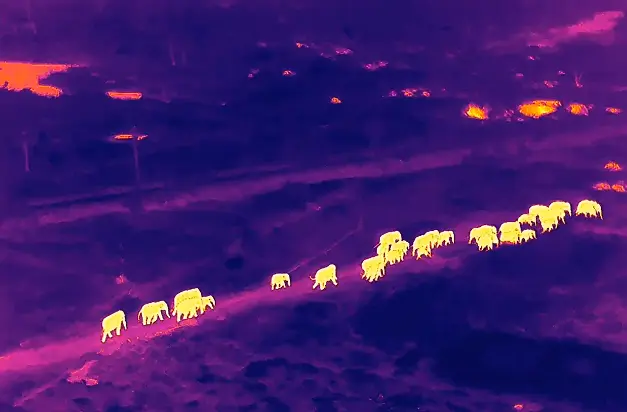
Bhubaneswar: A herd of elephants has been filmed walking in single file through a forest in Odisha’s Dhenkanal district, with thermal imaging technology capturing their journey even in near-total darkness.
The Dhenkanal Forest Division shared the video on Saturday. In the footage, the elephants stand out as glowing heat signatures against the cooler woodland around them, making it possible to follow their movement despite the absence of light.
The recording highlights how forest officials are increasingly relying on modern technology to observe wildlife at night, when ordinary cameras and direct monitoring become difficult.
How The Technology Works
Thermal cameras do not depend on visible light. Instead, they detect the infrared radiation naturally given off by living beings and objects, allowing forest officials and wildlife experts to spot animals that would otherwise remain hidden in the dark.
This makes the technology particularly useful for tracking elephants after sunset. Forest personnel can identify where a herd is moving and respond quickly if the animals head towards villages, farmland or roads.
Officials say monitoring elephant routes and movement patterns can help prevent human-elephant conflict by providing timely warnings and ensuring better planning, as reported by Deccan Chronicle.
Odisha’s Elephant Habitats
Odisha is one of India’s key elephant habitats, with herds spread across several districts. Apart from Dhenkanal, sizable elephant populations and elephant corridors are located in Angul, Sundargarh, Keonjhar, Mayurbhanj, Sambalpur, Deogarh, Boudh and Kandhamal.
Elephants are also known to pass through parts of Khurda and Rayagada, occasionally entering areas inhabited by people as they search for food and water.
Odisha’s forests give elephants essential shelter, food and pathways between fragmented habitats. However, shrinking corridors, expanding settlements, infrastructure, and farmland spreading along forest edges are reportedly disrupting their traditional movement routes.