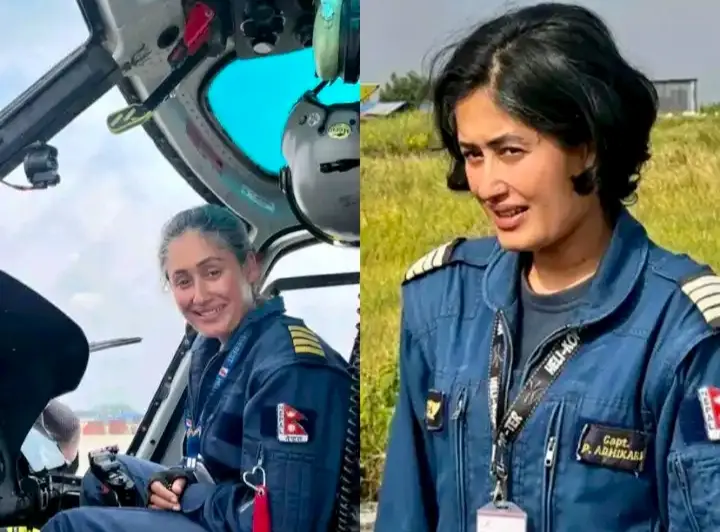
Kathmandu: “Everything is gone,” is how Captain Priya Adhikari, Nepal’s first woman helicopter captain describes the situation in the flood and landslide hit areas of her country.
Having flown over 100 rescue missions over the last seven days, she has emerged as one of the key figures in the country’s massive rescue operation since disaster struck along the Nepal-Tibet border.
Priya has helped evacuate survivors from some of the worst-hit areas, including Timure in Nepal’s Rasuwa district. The high-altitude rescue pilot has been operating in extremely difficult terrain, where thick mud, unstable ground and narrow valleys have made helicopter landings particularly dangerous.
She described the relentless rescue effort and the pressure of operating alongside dozens of other helicopters in a confined area, while speaking to CNN’s Anderson Cooper.
“Most of us are so exhausted because of all the flights we’ve been doing. We’ve been trained for this,” she said.
Priya is a veteran high-altitude helicopter pilot who specialises in search-and-rescue missions in the Himalayas. Her work has included rescuing injured climbers at extreme elevations, with some missions taking her to around 6,200 metres.
She had not started her career as a helicopter pilot. After studying environmental science, she worked as a member of a cabin crew. A helicopter joyride sparked her interest in flying, eventually prompting her to travel to the Philippines for helicopter training.
She became a full-time helicopter pilot in 2017 and went on to specialise in high-altitude rescue operations, after completing the required flying hours.
Priya’s experience is now being put to an extraordinary test. Timure, in Rasuwa district near the Nepal-Tibet border, has been among the worst-affected areas. Around 20 helicopters have been involved in rescue operations in the area, with pilots having to communicate constantly to coordinate landings and evacuations.
Five to six helicopters sometimes have to land at the same location to evacuate survivors, she said.
“The pilots must constantly coordinate over the radio, sometimes with five or six helicopters landing at the same spot to evacuate survivors,” she said.
The biggest challenge is the terrain though. Floodwaters and landslides have left thick layers of mud across parts of the affected areas. What may appear to be solid ground from the air can be unstable enough for a helicopter to sink.
Pilots sometimes cannot safely shut down their helicopters after landing and instead have to keep the aircraft powered while survivors are brought aboard, Priya said.
The view of the devastation is disconcerting, to say the least.
She recalled seeing bodies scattered across Timure after the flash flood. More than 200 survivors were evacuated from the area during the first two days of the operation, with several helicopters, including Nepal Army Augusta aircraft, taking part in the rescue effort, as reported by The Tribune.
“Everything is gone. Five hydropower projects are gone, lives are gone,” she said.
The sight of survivors waiting for rescue has kept her going, despite the death and destruction.
“Every time I go and land, I see people around and wave at them,” Priya said. “I say, you survived.”
There is an emotional toll of witnessing both survivors and those who did not make it out, she acknowledges. Although the people she rescues are strangers, Priya says the scenes remain deeply affecting.
The scale of the disaster, she said, has tested even her years of high-altitude rescue experience and was more difficult in some respects than what she witnessed during the 2015 Nepal earthquake.
Exhaustion has inevitably set in after nearly 100 missions in six days, yet Priya continues to fly as rescue teams race against time to reach people stranded by the flood and landslides.
While years of training in the Himalayas have prepared her for dangerous missions, the unprecedented scale of the current disaster has pushed those skills to their limits.
Still, her message remains simple: the pilots know what they have to do.
“We’ve been trained for this,” Priya says.