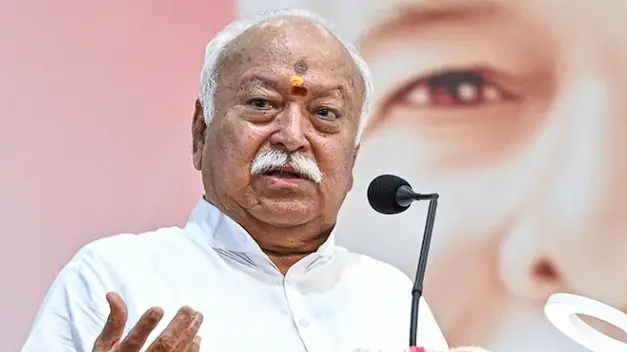
Washington: The US Commission on International Religious Freedom (USCIRF) has come out against a planned visit to the United States by RSS chief Mohan Bhagwat, scheduled for later this month in New York.
In a statement shared on X, USCIRF members said Washington should look at imposing sanctions on RSS members found guilty of violating religious freedoms.
“India’s PM Modi is a member of the Rashtriya Swayamsevak Sangh (RSS), an Indian umbrella organization whose sub-groups have perpetrated attacks on religious minorities, incl. Christians & Muslims. Now the RSS leader, Mohan Bhagwat, plans to visit the US,” said Asif Mahmood, chair of the US Commission on International Religious Freedom (USCIRF), an independent bipartisan federal advisory body established by Congress in 1998.
Its members are appointed by the President and top lawmakers although the organisation states that it functions independently of the US government, as reported by Hindustan Times.
Call To Deny Diplomatic Courtesies
“RSS leaders, even when affiliated with the Indian government, should not be honoured with high-level meetings or diplomatic courtesies. Instead, the USG should focus on imposing sanctions on RSS members found responsible for FoRB (Freedom of Religious Belief) violations,” added USCIRF member Gene Mills.
Earlier this year, the panel sparked a diplomatic row by recommending targeted sanctions against India’s external intelligence agency and the RSS. It also urged the US government to condition security assistance and bilateral trade with India on religious-freedom conditions in the country, while calling for India to be designated a “country of particular concern”.
To be clear, these recommendations carry no binding force for the US government and, so far, have not materially shaped the bilateral relationship.
MEA called it ‘misrepresentation’ earlier
MEA’s 2025 Rebuttal
Although India’s ministry of external affairs has not yet issued a formal statement in response to USCIRF’s latest statements, it has firmly repudiated the commission’s findings in previous years.
“The USCIRF’s persistent attempts to misrepresent isolated incidents and cast aspersions on India’s vibrant multicultural society reflect a deliberate agenda rather than a genuine concern for religious freedom,” India’s foreign ministry stated in 2025 in response to the agency’s annual report for that year.
“India is home to 1.4 billion people who are adherents to all religions known to mankind. However, we have no expectation that the USCIRF will engage with the reality of India’s pluralistic framework or acknowledge the harmonious coexistence of its diverse communities. Such efforts to undermine India’s standing as a beacon of democracy and tolerance will not succeed. In fact, it is the USCIRF that should be designated as an entity of concern,” the Ministry of External Affairs said last year.