Bhubaneswar: In a laudable achievement, Odisha is ranked 4th in industrial investments in the country, just behind big-ticket players like Gujarat, Maharashtra and Tamil Nadu, the latest Annual Survey of Industries has reported.
The Ministry of Statistics and Programme Implementation (MoSPI) released the Annual Survey of Industries report on 30 September. Specifically, the report was compiled and released by the ministry’s National Statistical Office (NSO), which serves as the principal agency for collecting and analysing industrial statistics across India.
According to NSO officials, the survey’s objective is to provide insights into the dynamics of change in the composition, growth and structure of various manufacturing industries in terms of output, value added, employment, capital formation and a host of other parameters.
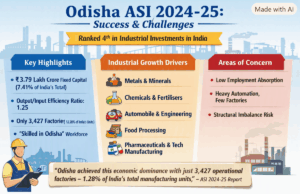
The survey also highlighted Odisha’s growing role in the country’s manufacturing landscape, by reporting that the state commands 7.41% of India’s total fixed capital, valued at nearly Rs 3.79 lakh crore.

Success Story
“Odisha achieved this economic dominance with just 3,427 operational factories, accounting for a minuscule 1.28% of India’s total manufacturing units. The figures reveal a state operating at breathtaking industrial efficiency, but they also expose a fascinating structural paradox,” the survey said.
The ASI 2024-25 also lauded Odisha’s efficiency, high-tech workforce and policy success.
On efficiency ratio, the survey said output‑to‑input efficiency stands at 1.25, higher than resource‑rich neighbours like Chhattisgarh.
ASI noted that the state’s push for a “Skilled in Odisha” workforce had worked wonders with engineers, technicians, and managers commanding premium salaries.
Hailing the success of the “Make in Odisha” strategy, the survey credited it with breaking the “resource curse by forcing downstream manufacturing and building mega‑infrastructure”.
Drivers of Growth
According to the survey, the top five industries (with over 45% share of Gross Value Added) that boost this boom are metals & minerals, chemicals & fertilisers, automobile & engineering components, food processing, and pharmaceuticals & technical manufacturing.
ASI said Odisha’s industrial strength is anchored in basic metals and mineral‑based industries, leveraging its rich resource base.
The chemicals & fertilisers sector led to growing downstream chemical and allied manufacturing units, while automobile & engineering components account for “emerging clusters supported by new industrial corridors”, it added.
The food processing sector is smaller, but an expanding one, linked to agro‑based industries. Driven by skilled workforce initiatives, pharmaceuticals and technical manufacturing are “niche, but rising”.
Areas of Concern
The survey, however, faulted the state’s “employment paradox”. Odisha is a a story of high capital, high efficiency, but low inclusivity. The state is a national industrial leader in terms of fixed capital and efficiency, yet struggles with limited factory numbers and employment absorption.
While heavy automation has driven high capital wealth and premium technical salaries, it has resulted in lower mass labor absorption, limiting job creation for unskilled workers.
Odisha also has low factory count. The survey said despite high asset volume, there are only 3,427 operational factories in Odisha, representing 1.28% of India’s total units.
ASI also warned of structural imbalance in Odisha, saying a “gleaming, high‑tech manufacturing engine” that generates wealth but rewrites the traditional capital‑labour relationship, potentially widening inequality.