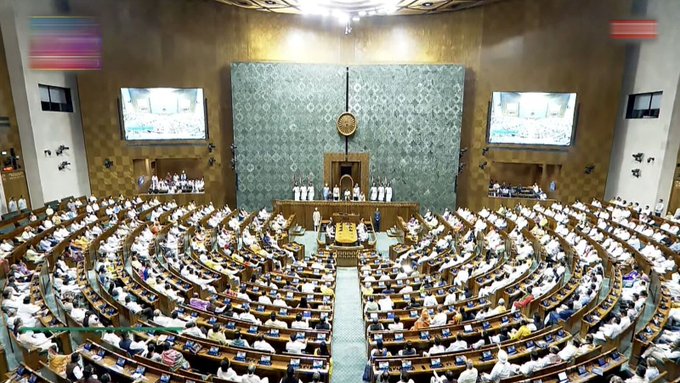
One of the most important responsibilities of elected representatives is to make laws. Parliament and State Legislative Assemblies are constitutional institutions entrusted with the responsibility of debating, deliberating and enacting legislation to meet the changing needs of society. Legislators, being representatives of the people with considerable experience of public life, are expected to understand public aspirations, identify emerging challenges and contribute meaningfully to the legislative process.
Unfortunately, the importance attached to this fundamental responsibility appears to be diminishing. Increasingly, legislative institutions are becoming arenas of political confrontation, sloganeering and partisan exchanges, often at the expense of meaningful debate and legislative scrutiny. This raises an uncomfortable question: Why are our legislators failing to perform one of their most fundamental constitutional responsibilities?
Ordinarily, legislative proposals are initiated by the government in the form of Bills. These are placed before the House for discussion and debate, examined in detail and adopted with or without amendments. Once passed by Parliament or the State Legislature, a Bill is sent to the President or the Governor, as the case may be, for assent. It then becomes an Act. This elaborate procedure is intended to ensure that proposed legislation is adequately examined, its implications understood and its provisions tested through informed debate.
There is also a provision for Private Members’ Bills, which individual legislators can introduce to draw attention to important public issues and suggest legislative interventions. Although very few such Bills eventually become law, they have historically served as instruments for initiating public debate and persuading governments to consider legislative reforms.
India’s parliamentary history is enriched by the contributions of several distinguished legislators who demonstrated exceptional intellectual ability, eloquence and statesmanship. In the decades following Independence, Parliament witnessed debates of remarkable quality. Members cutting across party lines participated in discussions with preparation, conviction and a deep understanding of the subjects under consideration. Legislative business was treated with the seriousness it deserved. General discussions were followed by detailed examination of individual provisions, and members sought clarifications, proposed amendments and scrutinised the implications of proposed legislation.
The debates were not merely exercises in political rhetoric. They reflected intellectual engagement, ideological differences and a genuine commitment to public interest. The proceedings attracted considerable attention from the media, and newspapers carried detailed accounts of the discussions for the benefit of citizens.
India has produced many outstanding parliamentarians whose contributions remain memorable. Atal Bihari Vajpayee, Madhu Dandavate, Piloo Modi, Kapil Sibal and P. Chidambaram, among others, demonstrated how intellectual depth, parliamentary experience and the ability to articulate arguments could enrich legislative debates. They represented different political ideologies, but their contributions to parliamentary discourse established standards worthy of emulation.
Odisha too has had its share of distinguished legislators who enriched the proceedings of the State Legislative Assembly through their knowledge, experience and debating skills. Ramakrishna Patnaik, Kalpataru Das, Prafulla Chandra Ghadai, Panchanan Kanungo, Prasad Harichandan, Amar Prasad Satpathy and Ranendra Pratap Swain are among those who have demonstrated considerable parliamentary acumen. Their interventions on matters of public importance and their understanding of legislative and administrative affairs contributed to the quality of discussions in the House.
However, the quality of legislative business in recent years has witnessed a noticeable decline, both in Parliament and in several State Assemblies. Bills are frequently passed without adequate discussion or meaningful scrutiny. On some occasions, important legislation has been passed amid protests, disruptions or even in the absence of opposition members. The time available for legislative business is increasingly constrained, while political confrontation consumes a disproportionate share of the proceedings.
What is particularly disturbing is the tendency to treat the passage of a Bill as a numerical exercise rather than a serious legislative responsibility. A government enjoying a comfortable majority may have the numbers to get its Bills passed, but numerical strength cannot be a substitute for intellectual scrutiny and democratic deliberation. The purpose of having an opposition is not merely to oppose the government but also to question, examine and suggest improvements in public policy and legislation.
There is also a growing concern about the quality of preparation among legislators. Effective participation in legislative proceedings requires considerable homework. Members must study the subject, understand the existing legal framework, examine the financial and administrative implications and assess the likely impact of proposed legislation on different sections of society. Unfortunately, debates often reveal inadequate preparation, repetitive arguments and political rhetoric rather than informed interventions.
The increasing tendency to refer important Bills to Parliamentary or Assembly Committees for detailed examination also deserves attention. Such committees provide an opportunity for cross-party discussions, expert consultations and stakeholder participation. They help identify deficiencies, ambiguities and unintended consequences in proposed legislation. Weakening this committee-based scrutiny can adversely affect the quality of laws and undermine institutional accountability.
Another disturbing development is the declining importance attached to Private Members’ initiatives. Individual legislators should be encouraged to bring forward legislative proposals on subjects that may not figure prominently on the government’s agenda. Such initiatives provide an opportunity to address neglected social concerns and introduce innovative ideas into public policy.
The consequences of poor legislative scrutiny can be far-reaching. Ill-conceived laws may create administrative complications, impose unnecessary burdens on citizens, generate litigation and sometimes require repeated amendments. A defective law does not merely reflect poorly on the legislature; it also affects governance and public confidence in democratic institutions.
It is important to remember that Parliament and State Assemblies are not extensions of political party offices. They are constitutional forums where public representatives are expected to rise above narrow political considerations and discharge their responsibilities in the larger public interest. The treasury benches have a responsibility to explain and defend government proposals, while the opposition has an equally important responsibility to examine them critically and offer constructive alternatives.
Ultimately, the quality of legislation determines, to a considerable extent, the quality of governance. A law passed without adequate discussion may serve an immediate political purpose but may fail to address the problem for which it was intended. Democratic legitimacy cannot rest exclusively on electoral mandates and majority votes. It must also be sustained through debate, consultation, transparency and accountability.
There is an urgent need to restore the dignity and seriousness of legislative institutions. Adequate time must be allocated for legislative business. Important Bills should ordinarily be subjected to committee scrutiny. Legislators should be encouraged to undertake research and prepare themselves before participating in debates. Disruptions and unnecessary adjournments must give way to constructive engagement. The performance of elected representatives should also be judged not merely by their political activities outside the House but by their contribution to legislative proceedings.
Democracy is not simply about winning elections and forming governments. It is equally about making good laws, protecting constitutional values and ensuring that the voices of citizens are reflected in public policy. Our legislators must remember that they are elected not merely to occupy seats in Parliament and Assemblies but to participate in the difficult and demanding task of nation-building through legislation.
If our legislators fail to legislate, who will? And if our legislatures cease to deliberate, what happens to the very essence of parliamentary democracy?
(Views expressed by the columnist are personal and do not necessarily reflect the opinion or policy of the news portal)