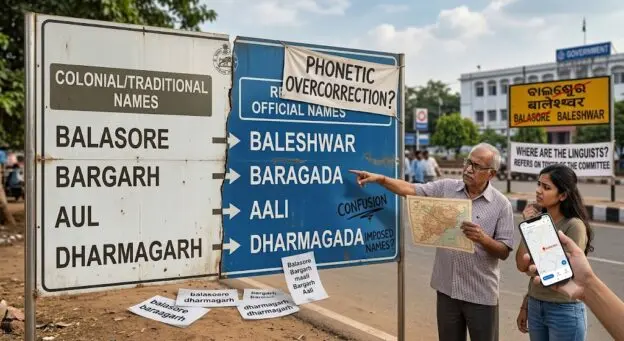
The Odisha government’s decision to revise the English spellings of several place names has reopened an old but important debate: How should Indian languages be represented in the Roman script?
At first glance, the objective appears laudable. Correcting colonial-era distortions and bringing official spellings closer to the original Odia names is a legitimate exercise. Changes such as Aul to Aali, Hinjilicut to Hinjilikatu, and Balasore to Baleshwar can be justified because the earlier spellings bore little resemblance to the original names.
However, many of the newer spellings seem to have crossed the line between sensible transliteration and phonetic overcorrection.
Take Bargarh, now rendered as Baragada. To an English reader, Baragada is far more likely to be pronounced “Bara-gada” than anything resembling the local pronunciation. Outside parts of coastal Odisha, very few people have ever called the town Baragada; for generations, it has simply been Bargarh. The same applies to names such as Jayapatana, Lanjigada, Junagada, Dharmagada, Bhabanipatana and Anugola. These spellings neither reflect widespread local usage nor make pronunciation easier for non-Odia speakers.
The problem lies in a fundamental misunderstanding of transliteration. Transliteration is not phonetic transcription. Its purpose is to represent one writing system in another while maintaining recognisability, consistency and ease of us
e. English simply does not possess exact equivalents for several Odia sounds, including the sound represented by “ଗଡ଼”. Attempting to force English spellings to capture every nuance of Odia pronunciation is therefore both impractical and linguistically unsound.
The inconsistencies are equally difficult to ignore. If Salipur becomes Salepur to reflect pronunciation, why not Salepura? If Dharmagarh becomes Dharmagada, why does that reflect only one regional pronunciation when locals themselves commonly say Dharamgad? The principles behind these revisions appear selective rather than systematic.
These questions naturally lead to another. Who constituted the expert committee that recommended these changes? Did it include linguists with expertise in both Odia and English phonetics, or was the exercise driven largely by administrative considerations? Language policy should be guided by rigorous scholarship, transparency and public consultation, especially when changes affect official maps, educational material, transport networks, government records and digital navigation.
There is no doubt that Odisha’s linguistic heritage deserves to be preserved. Colonial spellings need not be retained merely because they are old. But replacing one set of distortions with another is hardly progress. The purpose of official English spellings is to communicate effectively across linguistic boundaries, not to reproduce every phonetic detail of the source language.
A good transliteration system strikes a balance between linguistic authenticity, local identity and practical readability. That balance appears to be missing in many of the recent revisions. When official spellings become less intuitive for both English readers and many Odia speakers, it is reasonable to ask whether the exercise has achieved its intended objective.
Language evolves, but language planning must be guided by logic as much as sentiment. Transliteration should make names easier to recognise and understand—not harder.
(Views expressed by the columnist are personal and do not necessarily reflect the opinion or policy of the news portal)