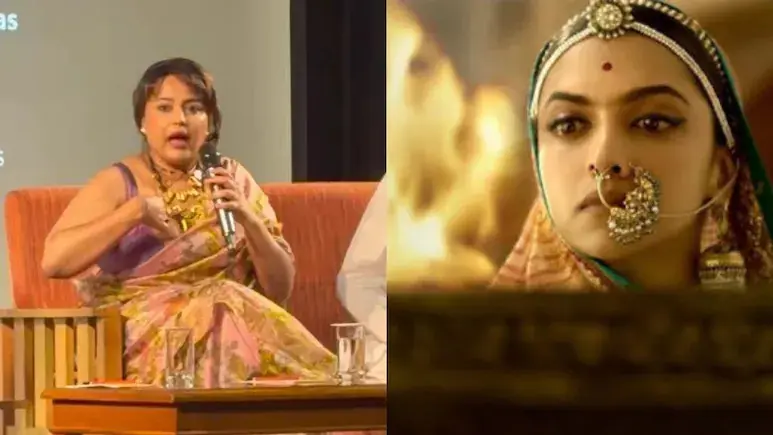
New Delhi: Swara Bhaskar has once again faced online backlash over her comments on the jauhar sequence in Sanjay Leela Bhansali’s ‘Padmaavat’, eight years after she penned an open letter criticising the film’s portrayal of the practice.
Speaking at a recent event in Delhi, Swara revisited her criticism and explained what had made her “mad” about the film.
She argued that portraying thousands of women choosing jauhar to protect their “honour” could send a troubling message to rape survivors who choose to live.
Her remarks have now resurfaced online, prompting a fresh wave of criticism, with some users accusing the actor of “wilful blindness”.
In a video from the Delhi event that has gone viral on social media, Swara is heard saying, “I’m watching this and it shows all these 800 women committing jauhar which is the story. Watching it I was thinking that ‘God forbid, I was a rape survivor, what is this film telling me? I would feel like a coward. That I didn’t kill myself to save my ‘honour.’”
She added, “Is that what you want to tell women in a society like ours where I feel like there’s any way a rape epidemic. Is that what we want to tell our survivors that you don’t deserve to live? That if you had actually been brave and honourable women, you would have killed yourself? Are we saying that rape is the end of a woman’s life?”
Swara also said ‘Padmaavat’ contained several elements that she found “just so problematic”.
“There was like one shot that made me so mad. I was like, ‘Chhee!’ There is a close-up of a pregnant woman’s belly and she’s going… So, you’re saying that a foetus that might be female doesn’t deserve to be born because she might be raped by a Muslim ruler? I was so mad and then I came out and I was like, ‘This is terrible’,” she recalled.
Swara’s comments have triggered sharply divided reactions online.
One user criticised her interpretation of jauhar, writing, “Madam #SwaraBhaskar, jauhar was not some impulsive response to a single incident of rape. It was rooted in the fear of capture, enslavement, sexual violence and the loss of dignity after defeat.”
Another user defended Swara, arguing that she was not calling the women who committed jauhar “cowards”, but was instead questioning the way the practice was portrayed in the film.
Another critic wrote, “Jauhar was and remains an act of utmost bravery in the face of unimaginable brutality,” while accusing Swara of showing “wilful intellectual blindness”.
Podcaster Richa Anirudh also reacted to the controversy, writing, “When intelligence, understanding, and sensitivity diminish… one should speak even less. #SwaraBhaskar”.
Another social media user accused Swara of disrespecting the women who committed jauhar and described them as “the bravest women ever born”.
The renewed debate has once again brought attention to the controversy surrounding ‘Padmaavat’ and the way the film depicted jauhar, honour and women’s agency.
In her 2018 open letter to Bhansali, Swara said watching ‘Padmaavat’ left her feeling “reduced to a vagina”.
She also criticised the filmmaker for what she described as the glorification of jauhar and sati in the film.
“Women have the right to live despite being raped, sir. Women have the right to live, despite the death of their husbands, male ‘protectors’, ‘owners’, ‘controllers of their sexuality’… whatever you understand the men to be,” she wrote.