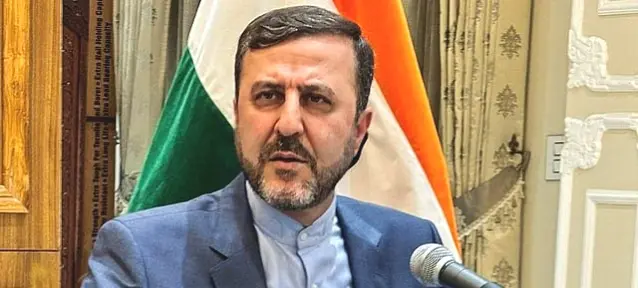
New Delhi: Iran may allow some more Indian vessels to pass through the Strait of Hormuz, the country’s deputy foreign minister Kazem Gharibabadi said on Wednesday, while welcoming any initiative by major powers like India to bring peace to West Asia.
Iran and Oman are developing a new service-and-payment-based framework for the passage of merchant vessels through the Strait of Hormuz in line with international norms, Gharibabadi said in New Delhi, as reported by PTI.
He pulled up the United Arab Emirates and said that a demand by “one member country” of the BRICS to condemn Iran has prevented the grouping from reaching a unified position on the regional conflict.
“We want India’s BRICS chairship to be successful. It is not a good approach to send a signal to the world that the BRICS is divided. One country is insisting to condemn Iran,” he said.
“We have not attacked neighbouring countries. They handed their territories to the US to launch an attack on us. We never insisted that Arab countries should be condemned as they allowed their military bases to the US,” Gharibabadi added.
India has displayed “impartiality” as a chair of the BRICS, the senior Iranian leader said a day before India hosts a conclave of the foreign ministers of the BRICS ahead of the annual summit of the grouping in September.
Iran’s foreign minister Abbas Araghchi and his Russian counterpart Sergey Lavrov are among those attending the two-day conclave that is expected to extensively deliberate on the West Asia crisis, including its impact on energy supplies.
Foreign policy experts are waiting to see if the foreign ministerial conclave manages to produce a consensus statement on the conflict in West Asia.
India’s efforts to build a consensus position on the conflict during a meeting of the grouping’s deputy foreign ministers and special envoys on the Middle East and North America last month was stalled due to sharp differences between Iran and the UAE – both members of the BRICS – over the US-Israel war on Iran.
Gharibabadi said that Tehran welcomes any initiative by New Delhi to bring peace and stability to West Asia that will be beneficial for all the countries in the region and beyond, while delving into historic, cultural and civilisational relations between India and Iran.
“India has always supported peace. It is in favour of peace and stability in the region. We will welcome whatever initiative India takes for peace,” he said.
In response to a question on Pakistan’s role as a mediator, the Iranian leader said that Tehran would welcome all such diplomatic efforts. “Pakistan is only a facilitator. We will welcome all such initiatives.”
Gharibabadi also said Iran is committed to the Chabahar port project and it is for India to decide how to move forward in view of the US sanctions on the project.
He said that Washington has suffered a strategic loss in the war and claimed that it is not serious in ending the hostilities through diplomacy.
His government will open the Strait of Hormuz if the US lifts its blockade of Iran’s ports, ends the war and releases Tehran’s frozen assets, the Iranian deputy foreign minister said.
His country is working with Oman on a framework for the passage of merchant ships through the key waterway in line with international norms and standards, Gharibabadi said.
Under the new initiative, Oman and Iran will provide navigational and other services to the merchant vessels and depending on the quantum of cargo and the size of the ships, fees will be charged, he said, elaborating on the provisional proposal.
“The Strait of Hormuz will be better than before once peace returns. There will be transparency, and we will not allow any discrepancy,” he said.
Iran allowed several Indian vessels to transit through the Strait of Hormuz and some more ships could be granted permission to head home, Gharibabadi said.
If the Strait of Hormuz is opened now, it could be used for military purposes against Iran, he claimed.
BRICS, originally comprising Brazil, Russia, India, China, and South Africa, expanded in 2024 to include Egypt, Ethiopia, Iran and the United Arab Emirates, with Indonesia joining in 2025.
It has emerged as an influential grouping as it brings together 11 major emerging economies of the world, representing around 49.5 per cent of the global population, around 40 per cent of the global GDP and around 26 per cent of the global trade.
The BRICS meeting will be chaired by External Affairs Minister S Jaishankar.