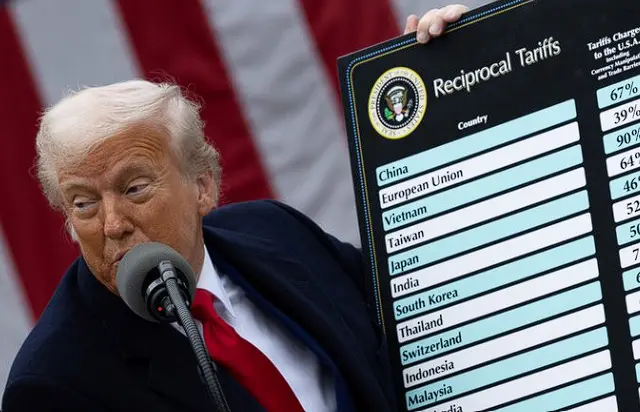
Washington: Twenty-five states have taken the Trump administration to court over its latest round of tariffs, arguing the White House is using the tariffs to get around a Supreme Court ruling in February that blocked an earlier plan.
The legal challenge, filed on Monday, says the administration’s latest import taxes are essentially a repackaged version of the tariff regime the justices had already rejected.
The suit comes as the federal government has moved to impose double-digit tariffs on 59 countries, and the European Union, saying those economies failed to do enough to stop goods linked to forced labour from entering the United States.
The new levies kicked in just as temporary tariffs that President Donald Trump had relied on after the Supreme Court loss were set to expire, as reported by The New Indian Express.
“After losing at the Supreme Court, the administration is once again trying to illegally raise taxes on families and businesses with a new round of tariffs,” said New York Attorney General Letitia James.
Besides New York, the plaintiffs include Arizona, California, Colorado, Connecticut, Delaware, Hawaii, Illinois, Kentucky, Massachusetts, Maryland, Maine, Michigan, Minnesota, Nevada, New Jersey, New Mexico, North Carolina, Oregon, Pennsylvania, Rhode Island, Virginia, Vermont, Washington and Wisconsin.
Trump, who has insisted that steep tariffs will help rebuild US manufacturing, broke with decades of American trade policy last year by pushing for higher import taxes and less openness in trade. He invoked the 1977 International Emergency Economic Powers Act, known as IEEPA, to place double-digit tariffs on imports from nearly every country, saying the country’s long-running trade deficit amounted to a national emergency.
But the Supreme Court ruled that IEEPA did not give him authority to impose tariffs. That ruling forced the administration to issue refunds to importers who had already paid the duties. Looking for a new source of revenue, Trump then shifted to temporary worldwide tariffs of 10%, but those expired at midnight of July 24.
Section 301 Fight
Now the administration is leaning on a more enduring legal tool: Section 301 of the Trade Act of 1974, which allows the president to levy import taxes and other penalties on countries judged to be engaging in unfair trade practices. Trump used that authority during his first term to impose major tariffs on China, and those survived courtroom challenges.
The administration says it used Section 301 to impose the forced-labor tariffs, which range from 10% to 12.5% and affect countries that account for 99% of U.S. imports.
“The United States is using its lawful authority to obtain the elimination of unreasonable acts, policies, and practices that burden US commerce,” White House spokesman Kush Desai said.
“A foreign country’s failure to impose and effectively enforce a prohibition on the importation of goods produced with forced labour is unreasonable and burdens US commerce, including American workers, and must be addressed. Section 301 tariffs have proven to be a legally durable tool since the President’s first term, and they remain so now.”
The states’ lawsuit follows two other cases filed in July in the Court of International Trade by small businesses that also took aim at the Section 301 tariffs.
Those suits contend the government failed to build a proper record against each individual economy and did not explain how the tariffs would actually eliminate the conduct they were meant to target, as Section 301 requires.
Barry Appleton, a law professor and co-director of New York Law School’s Center for International Law, said the new litigation reflects the fact that the administration has now tried three different statutory routes to impose similar global tariffs, and that the near-identical structure of those efforts could make them harder to defend.
Still, he noted that unlike the earlier legal theories, Section 301 is not new territory for the courts.
During Trump’s first term, he used Section 301 to hit Chinese imports with tariffs that withstood legal scrutiny.