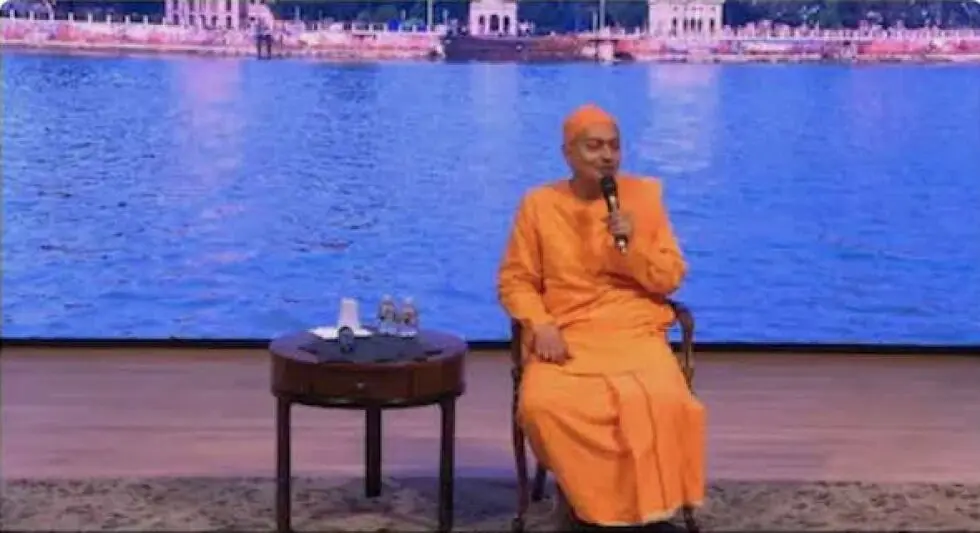
When Anthropic, the American AI safety and research firm invited Swami Sarvapriyananda to its San Francisco headquarters to contemplate consciousness and ethics for its CLAUDE AI assistant, the technology vanguard conceded a vital truth – engineering challenges of artificial intelligence have collided head-on with classical metaphysics.
While AI companies are currently preoccupied with whether Claude, GPT, or their successors can develop an authentic sense of self or attain moral agency, for educators standing in classrooms worldwide, this debate addresses the wrong side of the screen. The most pressing catastrophe of the algorithmic age is beyond the question of whether synthetic minds will embrace a code of ethics or lack compassion. It is the fact that human beings, lulled by frictionless convenience, will surrender the very habits that make them humane. The true danger to human beings is moral atrophy engineered by AI.
In the Nicomachean Ethics, Aristotle argued that virtue is not a theoretical database of rules, but a practical capacity. “Phronesis” or practical wisdom is forged through repetitive, often uncomfortable deliberation. One does not become “just” or fair by reciting axioms. Rather, one becomes “just” by performing just acts, navigating nuances, and enduring friction, i.e. willingly staying with the difficult, messy, and uncomfortable parts of moral decision-making and human interactions rather than taking an easy, automated shortcut.
Friction is the vital resistance we encounter when we struggle through an ethical dilemma, navigate a disagreement with another person, or puzzle over a complex problem without letting an algorithm or a shortcut do the thinking for us. Just as physical muscles require resistance (friction) to grow strong, our moral and intellectual faculties atrophy if they never meet resistance. Enduring friction means accepting discomfort, patience, and unscripted deliberation as essential ingredients for building true character, empathy, and independent judgment.
Generative artificial intelligence now functions as a universal solution for human friction. When students download literature, calculation, ethical reflection, peer mediation, and decision-making from synthetic prompts, the “moral muscle” ceases to contract. If an automated assistant composes our apologies, arbitrates our ethical dilemmas, and drafts our condolences, we turn moral behaviour into a consumption habit rather than an embodied choice. We become what C.S. Lewis warned against in “The Abolition of Man” – “We make men without chests and expect of them virtue and enterprise.”
The mechanisation of inner life directly degrades our treatment of one another. The twentieth-century philosopher Martin Buber distinguished between two relational stances:
The I-Thou encounter: Entering a reciprocal, vulnerable relationship that honours another entity’s depth.
The I-It relation: Treating an entity as a tool to be managed, manipulated, or extracted from.
By definition, every interaction with an AI agent is I-It. An algorithm does not demand patience, tolerates our worst temperaments without offence, and provides infinite validation. Modern sociologists like Sherry Turkle, who studies how human relationships are shaped by digital technology, observe that humans exposed to frictionless machine relationships become less tolerant of messy, inconvenient human relationships.
When young minds spend formative years commanding frictionless synthetic intelligences, they naturally export those relational expectations onto real people. Empathy shrivels. When other people become inconvenient, frustrating, or resistant to our preferences, the temptation is to treat them as broken interfaces rather than sovereign beings.
Therefore, the recent incident of a dialogue between AI labs and classical traditions like Advaita Vedanta are illuminating, yet they expose a central blind spot of the tech industry. In Vedantic philosophy, true ethics flows from Atman (soul) and the direct realisation that consciousness is shared and universal. To harm or neglect another is, fundamentally, to harm oneself. Morality is inseparable from felt, subjective unity.
Modern corporate AI safety frameworks often confuse morality with compliance or training a model on guardrails, policy filters, and “constitutional AI.” This confuses an ethical posture with an optimization problem. If future generations grow up believing that morality is merely compliance optimization handled by software, we step closer to Theodor Adorno’s post-war diagnosis that modern barbarism emerges whenever technical rationality divorces itself from genuine moral sensitivity because that is exactly when rational efficiency replaces human conscience.
If education metamorphoses into merely the transmission of skills that AI can automate faster and more accurately, we fail our students completely. The mission of pedagogy in the algorithmic century must therefore reclaim moral struggle. The teaching-learning system needs to deliberately incorporate pedagogical friction like prodding students into live, unscripted debates, ethical paradoxes, and sustained interpersonal service where answers cannot be generated with a prompt. It must cultivate phronesis over speed and amply reward the process of moral reasoning, self-interrogation, and empathy, over neat, polished synthetics. It must root learning in the intersubjective by prioritizing shared human presence, communal dialogue, physical craftsmanship, and real-world civic responsibility.
This is where the Shrimad Bhagavad Gita – A Curriculum for Schools emerges as a safe anchor. By serving as an essential shield against modern moral atrophy, this curriculum serves as a life skills manual, gently steering young minds away from frictionless automation toward conscious duty. It cultivates true phronesis by grounding students in ethical resilience, emotional depth, and purposeful, values-driven action.
The ultimate test of our era will not be whether an engineered neural network can mimic the compassion of a saint. It will reflect in whether the generation raised in its shadow still remembers how to feel it.
(Views expressed by the columnist are personal and do not necessarily reflect the opinion or policy of the news portal)