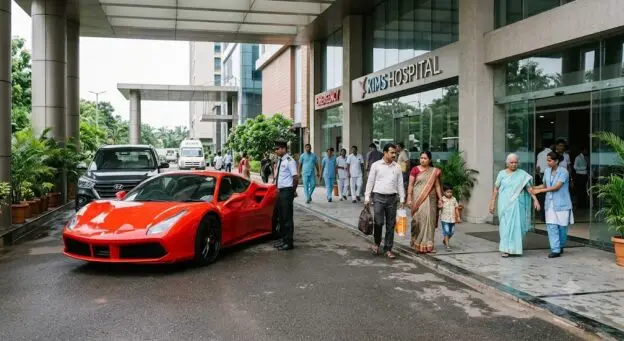
There are few things as beautiful as a Porsche. I saw one today, a magnificent machine in shining red, parked at the entrance of a top-tier private hospital in Bhubaneswar. I cannot quite explain what I felt when I saw it. It was one of those moments when words fall short of describing the sheer beauty of an object. I am not sure I have seen another Porsche of the same kind in Bhubaneswar. It was a showstopper, its beauty and grandeur impossible to miss. Fascinated, I turned to my mother, whom I had taken to the hospital for an eye consultation, and asked jokingly, “Are patients coming to hospitals in cars like these?” She looked at it innocently and replied that perhaps it was the only car its owner possessed. I laughed to myself. The only car? Surely, someone who could afford a Porsche and that too a thoroughbred (as the company calls it) in Bhubaneswar must have a few more in the garage!
Later, I learnt that the car belonged to a young physician at the hospital. And that is when my admiration began to collide with a series of uncomfortable questions.
As I looked at the people milling around the hospital entrance, the attendants, patients, security guards and drivers, I could not help noticing how impoverished they appeared in comparison with the red machine. Not necessarily impoverished in the literal sense, but diminished by the sheer contrast. Somewhere in this very hospital, a man or woman might be struggling to arrange money for a medical procedure, selling a piece of ancestral land, mortgaging a wife’s jewellery or borrowing from relatives to pay a hospital bill. A little further down the road, that same person is seen eating a ₹70 vegetarian meal at one of those roadside establishments where food is ready and affordable. The contrast was difficult to ignore. The symbols of wealth were on display; the sacrifices that might coexist with them were not.
And then a thought occurred to me that I could not easily dismiss: the man eating that ₹70 meal might be the very person paying for the Porsche. Not by purchasing the car directly, of course, or through a particular bill that can be traced to that vehicle. The relationship is larger and more troubling than that. Every consultation fee, diagnostic test, prescription, procedure and hospital bill contributes to the financial ecosystem of healthcare. Collectively, millions of ordinary people, including those who must borrow to pay for treatment, sustain a market in which some participants can accumulate extraordinary wealth. The patient may be selling land to pay for care, while the system receiving his money may be generating returns that place luxury cars within reach. He is not merely standing beside the wealth of others. His payments help keep the economic machinery turning, even when he cannot afford to protect his own family from the financial consequences of illness.
I do not know how the young physician acquired the car, nor do I presume to know the circumstances of his wealth. He may have earned it through years of hard work, professional excellence, investments or other legitimate means. That is not the point. The question that stayed with me was a larger one: what kind of economic system makes such extraordinary wealth possible within a profession that exists, at least in its noblest conception, to serve humanity? How much money must circulate through a system for such conspicuous accumulation to become possible? And how should we understand the distribution of that money when the people who help generate it may be among those least able to afford the service itself?
We understand that businesses need to make profits. Doctors invest years in education and training; hospitals require infrastructure, equipment, personnel and expertise. Nobody can reasonably expect medical professionals to work without adequate remuneration. But somewhere between earning a legitimate living and accumulating extraordinary wealth lies a question we seem reluctant to ask. When does the economics of healthcare begin to conflict with its ethics? When does the pursuit of financial returns overshadow the obligation to care? And how do we distinguish wealth generated by creating genuine value from wealth accumulated in a system where the person paying may neither possess the knowledge to question the charges nor have the freedom to refuse the service? In most markets, a customer can walk away. A person in pain, frightened by a diagnosis or desperate to save a loved one does not always have that luxury.
The question becomes even more troubling when we consider the role of the State. Under schemes such as Ayushman Bharat and Odisha’s Gopabandhu Jan Arogya Yojana, public money helps finance treatment through empanelled private hospitals. Such arrangements can give patients access to facilities that might otherwise be beyond their reach. But they also raise a fundamental question about priorities. Why must the State continually purchase healthcare from private providers without giving equally serious attention to building and strengthening its own hospitals, diagnostic facilities, medical colleges and specialist services? Public expenditure can help a citizen obtain treatment today, but public investment can also create capacity that serves generations. The two approaches can coexist. What deserves scrutiny is the balance between them, the incentives they create and the distribution of their financial benefits. When taxpayers’ money helps sustain a private healthcare market, citizens have every right to ask who benefits, what the public receives in return, and whether the same resources could build a more equitable and enduring system. The question is not whether private hospitals should exist. It is whether public policy should allow the growth of private wealth to become a more visible measure of success than the public’s ability to obtain affordable care.
This is not an argument against doctors becoming wealthy. It is an argument about the moral legitimacy of treating an essential human need as an opportunity for extraordinary private enrichment without asking sufficiently difficult questions about how that enrichment occurs. A patient does not approach a doctor in the same way that a customer walks into a showroom. The power imbalance is inherent in the relationship. When illness can force a family to surrender its savings, land and future earnings, the financial consequences of medical decisions cannot be separated from the ethical obligations of those who make them. Healthcare must have an economic dimension. But should its economics be permitted to operate without sufficient regard for human vulnerability at its centre? And who is responsible for examining a arrangement in which the money of people who are financially vulnerable helps sustain a system in which others acquire so much?
And this is India, being a welfare state, a country that speaks endlessly of its civilisational heritage, its traditions of compassion, seva, karuna and dharma. We celebrate our culture and proclaim our benevolence, yet we have become accustomed to a reality in which illness can impoverish a family while extraordinary wealth accumulated within the same healthcare economy is held up as a symbol of success. What does compassion mean when a family must mortgage its future to pay for treatment? What does seva mean when financial returns can compete with the needs of a patient? And what does it say about our collective consciousness when we admire the visible rewards of a system but seldom ask about the invisible sacrifices that help sustain it? The contradiction is not simply between a rich person and a poor person. It is between the values we proclaim and the economic arrangements we have learnt to accept.
I returned home after my mother’s consultation, but the encounter stayed with me. I had begun the day admiring an extraordinary piece of engineering. I ended it thinking about the conditions under which extraordinary wealth accumulates, and about how readily we celebrate its visible rewards without examining the economic arrangements behind them. The person eating the ₹70 meal might have seemed entirely disconnected from the world represented by the car. But the two were not as distant as they appeared. Between them lay a vast economic system, sustained by patients’ payments, shaped by public policy, influenced by professional authority and normalised by our collective acceptance of what healthcare has become.
I keep returning to one question. Why should a person have to sell land or mortgage jewellery to obtain healthcare, while the system he pays into can generate extraordinary private wealth? Why do we scrutinise the inability of the poor to pay more readily than we scrutinise the arrangements that determine what they must pay? Why is the financial vulnerability of a patient treated as an unfortunate fact of life, while the wealth accumulated within the same system is treated as an unquestionable reward for success? And why, in a society so proud of its moral inheritance, have we become so comfortable with this contradiction?
I cannot deny the beauty of what I saw that day. But I cannot separate that beauty from the thought of the man eating his ₹70 meal, and of the possibility that the money he struggles to find when illness strikes helps sustain the world in which such a car becomes possible. Perhaps the most uncomfortable question is not who deserves to own a Porsche. It is why we have built and accepted a system in which the person who helps pay for it may have to mortgage his future to afford the care that keeps him alive. What, then, have we learnt to admire? What have we learnt to accept? And what have we simply stopped questioning?
The striking red Porsche that had so captivated me began to look less like an object of exquisite beauty and more like a vulgar display of wealth, its magnificent presence at the entrance of a hospital—where human suffering, financial desperation and the fragile dignity of life were on such painful display— turning my admiration into an uncomfortable sense of shame.
(Views expressed by the columnist are personal and do not necessarily reflect the opinion or policy of the news portal)