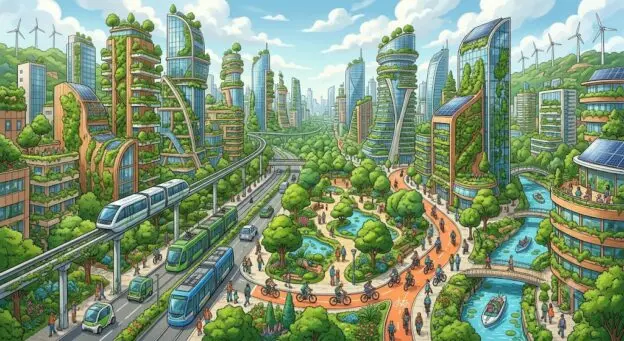
Urban sustainability initiatives regularly make headlines. Cities, for example, have received much attention for new bicycle lanes and a generalised speed limit of 20 km/h for motorised traffic. Havana, Cuba, is famous for its urban agriculture; Curitiba, Brazil, is a pioneer in bus rapid transit systems; and Amsterdam, the Netherlands, is referred to as the world’s cycling capital. Yet, often enough, when cities are featured in the news, headlines sound the alarm on the detrimental impacts of unsustainable urban development: Jakarta, Indonesia, is sinking; New Delhi, India, shut down schools amid high levels of air pollution; and residential buildings are collapsing due to a lack of maintenance in Marseille, France.
The proportion of the world’s population living in urban areas grew from 30% in 1950 to 55% in 2018 and is projected to reach 68% by 2050, with almost 90% of the projected increase expected to take place in Asia and Africa. In 2018, 24% of the global urban population lived in slums—often with limited access to basic services—with that proportion reaching as high as 56% in Sub-Saharan Africa. Urban land area more than doubled between 1992 and 2018, significantly contributing to biodiversity loss. Yet, cities remain powerhouses of economic growth, generating roughly 60% of global Gross Domestic Product (GDP).
Although sustainable urban development is receiving increased attention, the topic is far from new. The 1972 Stockholm Declaration noted: “Planning must be applied to human settlements and urbanisation with a view to avoiding adverse effects on the environment and obtaining maximum social, economic, and environmental benefits for all.” The question of how to ensure sustainable urban development has remained at the top of the global agenda ever since.
Local governments are the key players in fostering urban sustainability, as they can enact measures directly within their jurisdiction. However, building sustainable cities is not solely the responsibility of local authorities. Other actors also possess the power to steer cities toward sustainability. Regional and national entities can influence outcomes by adopting specific policies and standards, altering norms, or opening new funding opportunities. This includes state, provincial, or regional governments in federally structured countries, supranational entities, and multilateral fora. Furthermore, non-governmental actors—including businesses, civil society organizations, schools, research institutions, and faith-based organizations—are essential agents of change.
Progress often relies on dynamic interactions between these diverse actors. Nevertheless, fostering urban sustainability remains a protracted undertaking. Key challenges include local governments lacking the autonomy, fiscal resources, or human capacity needed to implement sustainability measures, as well as pushback from powerful central authorities or large corporate interests. Fortunately, many new approaches to sustainable urban development are breaking away from the long-predominant mindset of “taming nature” and are instead reintroducing greenery into the concrete jungle. Urban agriculture, for instance, is gaining significant ground in the collective vision of sustainable cities.
More broadly, there is a strong shift toward what is increasingly termed “nature-based solutions.” Urban water management offers several clear examples: New York City is actively restoring oyster reefs; cities like Seoul are day-lighting streams buried under concrete for decades; and China is promoting the development of “sponge cities.” Rather than relying exclusively on hard engineering, these cities leverage natural infrastructure to achieve multiple benefits—not only enhancing flood management but also expanding recreational space and supporting biodiversity. Many such measures address climate change from an adaptation and resilience standpoint, mitigating urban heat island effects and reducing flooding from heavy precipitation and storm surges. Plants are no longer confined to ground level; they are increasingly integrated into rooftops and building facades.
Cities are also grappling with the detrimental effects of decades of car-centric urban planning, which encouraged urban sprawl, created barriers to alternative transit, drove up municipal greenhouse gas emissions, and worsened localised air pollution. Multimodal transportation initiatives are now sprouting globally in various forms: establishing road congestion pricing (Singapore; London), offering free public transit for residents (Aubagne, France; Tallinn, Estonia), installing aerial cable cars (Medellín, Colombia; Constantine, Algeria), and prioritizing traffic signals for cyclists by default or during rainy weather (Odense, Denmark; Rotterdam, the Netherlands).
Recently, while inaugurating the National Urban Conclave-2026 in Bhubaneswar, the Odisha government reiterated its commitment to developing modern infrastructure and institutions to support the state’s rapid urban expansion. Odisha aims to increase its urbanization rate from the current 17 percent to 40 percent by 2036, outlining an ambitious vision for planned urban growth and a $500-billion economy by the centenary of its statehood. However, to translate this vision into reality, the state government must empower local authorities, as they are essential to unlocking India’s urban growth potential. Cities cannot be effectively governed solely from state capitals; local governments require both the authority and institutional capacity to respond to local needs. This decentralised empowerment is key to ensuring meaningful citizen participation and realizing the vision of a Viksit Odisha and Viksit Bharat.
As we mark World Sustainability Day on the fourth Wednesday of October, we must reaffirm our commitment to ecological preservation and the protection of natural systems that sustain life. With an increasing population settling across urban Odisha, coupled with the worsening impacts of climate change and natural resource depletion, the magnitude of the urban sustainability challenge demands decisive action. This calls for a holistic rethinking of how to make cities livable for all while minimising environmental impacts. Achieving sustainable cities requires breaking down silos between different levels of government and overcoming vested interests committed to the status quo. It demands looking beyond city boundaries to strengthen urban-rural linkages, foster circular resource loops, and decarbonize the energy, transport, and building sectors. Above all, urban sustainability requires cross-sectoral planning tailored to the diverse needs of all city residents so that no one is left behind. While there is no single blueprint for what a sustainable city looks like, cities like Bhubaneswar have a unique opportunity to lead by example and set a benchmark for the world.
(Views expressed by the columnist are personal and do not necessarily reflect the opinion or policy of the news portal)