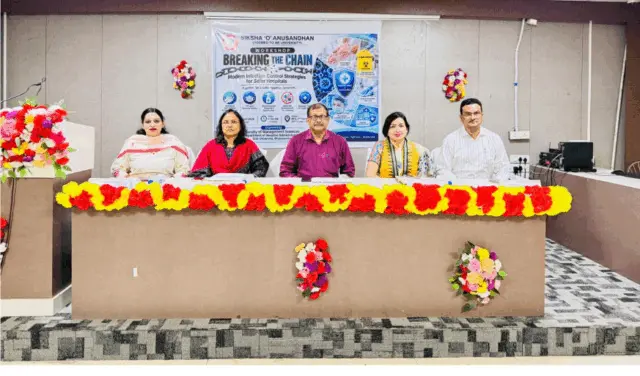
Bhubaneswar: A workshop on ‘Breaking the Chain: Modern Infection Control Strategies for Safer Hospitals’ was organised by the Department of Hospital Administration of the Institute of Business and Computer Studies, faculty of management sciences of SOA Deemed to be University in Bhubaneswar.
The workshop, held on Monday, focused on the critical question in healthcare– how can hospitals systematically prevent infections by identifying and breaking every link in the chain of infection?
It aimed to strengthen awareness that infection control was not the responsibility of microbiologists alone but a shared responsibility of hospital administrators, doctors, nurses, support staff and every stakeholder involved in patient care.
The technical sessions were led by eminent infection-control experts, Purabi Baral, Head of Department of Microbiology and Hospital Infection Control Officer, SUM Ultimate Medicare, and Pragnya P Jena, Infection Prevention and Control Officer, Bio-safety Officer and Associate Professor, Department of Microbiology, Institute of Medical Sciences and SUM Hospital, who shared their expertise on modern infection-control practices and strategies for breaking the chain of infection.
Ayasa Kanta Mohanty, Dean of IBCS, delivered the welcome address while Preeti Y Shadangi, MHA Program and Workshop Coordinator explained the workshop theme.
Manoranjan Dash, Associate Dean, IBCS, who delivered the keynote address, emphasized the integration of microbiology, infection control and hospital management to effectively break the chain of infection. He drew an insightful connection between modern infection control and Odisha’s rich cultural heritage highlighting the ‘Anasara’ tradition of Lord Jagannath as a metaphor for seclusion, protection and prevention, thereby linking ancient wisdom with contemporary scientific practices. He spoke on the common principles of protection, restricted exposure and prevention for infection control.
The workshop focused on hand hygiene, PPE, isolation, environmental cleaning, biomedical waste management, healthcare-associated infections, infection surveillance and anti-microbial resistance.