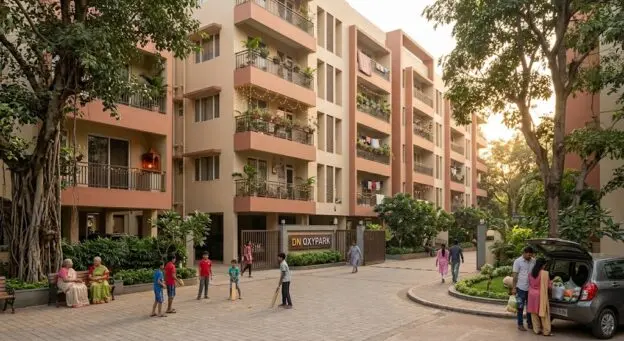
A few days back, I visited DN Oxypark, one of our premium residential projects, to meet a close friend who lives there. He had purchased his apartment in 2012 and moved in soon after possession was handed over in 2016.
DN Oxypark has always held a special place in my heart. I was closely involved with the project from the very beginning, from the purchase of the land to its planning, construction, and finally the handing over of homes to our customers. I had watched it first exist as an idea, then as drawings on paper, and gradually rise from the ground as a physical structure.
Whenever I visit the property, I feel a positive energy within me. As I walked around that day, everything appeared beautiful, serene, and peaceful. The greenery had matured, the surroundings had acquired their own rhythm, and the buildings seemed completely at ease with the lives unfolding within them.
Yet I realised that the DN Oxypark I was visiting was no longer merely the project we had completed and handed over in 2016. Over the years, its residents had added something that no architect, engineer, or builder could have created.They had given it life.
The apartments that were once empty spaces were now filled with families, conversations, prayers, celebrations, memories, and dreams. Balconies had become favourite corners. Dining tables had witnessed countless family discussions. Children had grown up within those walls, and neighbours had gradually become friends.
Standing there, a thought came to me: we may construct a building, but we cannot construct a home.
A building is made from lifeless materials — brick, cement, steel, sand, stone, and glass. Architects give it imagination, engineers give it strength, and builders give it physical form. But only the people who live within it can give it a heartbeat.
That is when a building becomes a home.
Perhaps a house-warming ceremony is called Griha Pravesh for this very reason. It is not simply about a family entering a new structure. It marks the moment when human warmth, prayer, hope, and relationships enter an otherwise silent space.
The first lamp is lit. The first meal is prepared. Someone chooses a favourite corner. A child runs from one room to another. Dreams begin to find their addresses.
Slowly, the walls learn to listen.
They hear the hurried conversations of busy mornings, the laughter around the dining table, and the whispered prayers of sleepless nights. They witness birthdays, festivals, examinations, illnesses, marriages, and departures. They protect secrets that may never travel beyond them.
I have often felt that a home smiles and cries with its occupants.
When happiness enters, the entire house seems to brighten. During a wedding, even its walls appear festive. During birthdays, festivals, and family reunions, laughter travels from room to room, filling every corner with energy. But when sorrow arrives, the same house becomes unusually quiet. The curtains remain drawn. The dining table loses its conversations. A particular chair suddenly looks empty. Without speaking a word, the home mourns with the family.
Perhaps this is why leaving an old home can be so painful.
We may tell ourselves that we are leaving behind only brick and mortar, but our hearts know otherwise. We are leaving the wall against which a child’s height was measured, the balcony where our parents waited for us, the room where difficult decisions were taken, and the corner where we once sat alone and gathered the courage to begin again.
A home remembers versions of us that the world may never have known.
Like every living being, a home also needs to breathe. Its doors and windows are its lungs. Sunlight and fresh air are essential to its health. It needs water, energy, cleanliness, repair, and regular care. If neglected for long, even the strongest structure begins to crumble.
But a home requires more than physical maintenance. It also needs emotional nourishment.
Love is its warmth. Trust is its foundation. Communication is its oxygen. Respect strengthens its walls, and forgiveness repairs the cracks that inevitably develop in every relationship.
A healthy and happy home does not mean a home without arguments, disappointments, or difficult days. No family can avoid them. A happy home is one in which disagreements do not become permanent distances; where mistakes can be admitted, forgiveness can be sought, and every member feels heard, respected, and valued.
We often invest great effort in beautifying our houses. We select the finest flooring, furniture, curtains, colours, and lights. All of these make a house attractive, but they cannot make it loving. A beautiful dining table cannot create conversation. An expensive kitchen cannot guarantee that a family will eat together. A large living room cannot create closeness, and the most luxurious bedroom cannot bring peace to a restless mind.
The most valuable elements of a home are rarely purchased. They are created in the cup of tea made for someone after a tiring day; in a parent waiting at the door; in siblings laughing over old memories; in the patience to listen; and in the assurance that even when the world misunderstands us, there is one place where we do not have to explain who we are.
A house shelters the body. A home shelters the soul.It is our first school, where we learn love, responsibility, sharing, patience, and sacrifice. It is also our first temple, where gratitude is practised, blessings are received, and values are passed silently from one generation to another.
A healthy and happy home nurtures our dreams before the world recognises them. It restores us after failure, keeps us grounded during success, and gives us the courage to begin again. It uplifts our thoughts and enlightens our lives.
As builders, we can create strong foundations, enduring structures, and beautiful spaces. But the most important construction begins only after we hand over the keys. It is undertaken every day by the people who live there, through their words, their choices, their relationships, and the love they give one another.
We may travel across cities and countries in search of opportunity, achievement, and happiness. We may stay in grand hotels and admire magnificent buildings. Yet after every celebration, every struggle, and every journey, the heart looks for that familiar door behind which it can rest without pretence.Because, at the end of the day, all roads lead to home.
(Views expressed by the columnist are personal and do not necessarily reflect the opinion or policy of the news portal)