Some journeys take us to a destination. Others quietly change the way we see life.
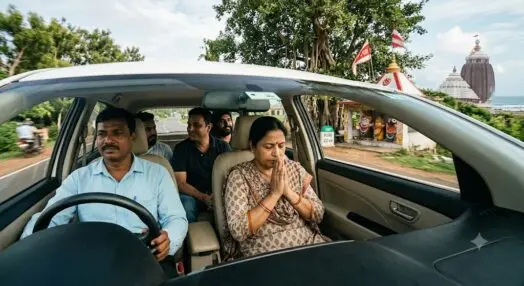
One such journey happened nearly fifteen years ago, when four of us were travelling to Puri for darshan of Lord Jagannath. We were Jagadish Prasad Naik, MD, DN Group; Punit Beriwala, MD, Vipul Ltd.; Guninder Singh, Chief of Architecture and Planning, Vipul Ltd.; and me.
As our car moved towards Puri, I kept doing something almost unconsciously. Whenever we crossed a temple, I would fold my hands, close my eyes and bow my head.
It did not matter whether it was a magnificent temple with a towering shikhara, a small roadside shrine or simply an idol placed beneath a tree.
Folded hands. Closed eyes. A silent prayer.
A few kilometres later, another temple—and the same ritual again.
After observing me for some time, Punit ji finally asked:
“Ratna, do you really believe in God? And what do you pray for? What exactly do you ask God to fulfil?”
It was a simple question, but I suddenly realised that I had never examined my own faith.
What was I asking God for?
Success? Health? Money? Protection? Happiness? Peace?
I had no ready answer. So, I gave him the most honest and innocent reply:
“Punit ji, honestly, I fear all Gods and Goddesses!”
Everyone laughed, but I was serious.
Jagadish looked at me in surprise and asked:
“Ratna, do you really fear anything or anybody?”
“Of course I do,” I replied. “And I have very good reasons!”
“If I do not pray to Lord Mahadev, what if the snake around His neck bites me someday? What if His powerful Nandi attacks me with his horns?
“If I do not pray to Lord Krishna or Lord Narayan, what if His Sudarshan Chakra separates my head from my body?
“If I do not pray to Maa Lakshmi, what if She becomes angry and withdraws Her blessings, leaving me to struggle like a beggar?
“If I do not pray to Maa Durga, She may make me powerless. After all, She defeated Mahishasura with Her Trishul.
“And if I do not pray to Lord Ganesha, He may withdraw my luck and wisdom and, instead of removing my obstacles, create a hundred more!”
The car filled with laughter.
Yet, beneath my humorous answer lay a deeper truth: my faith had begun with fear.
I prayed because I was afraid of losing God’s blessings. I prayed because I feared divine displeasure. Perhaps, like many of us, I had initially understood God through the language of reward and punishment.
But that journey to Puri planted a question in my mind that would take me many years to answer:
Is faith born out of fear really faith?
I have always considered myself a fearless person. I take difficult decisions, face uncomfortable situations and rarely allow fear to stop me.
But life has taught me that being fearless does not mean having no fear. Sometimes courage is simply the decision to keep moving forward while fear walks beside us.
I discovered that I had many fears: fear of failure, fear of making the wrong decision, fear of disappointing people, fear of losing something I had worked hard to build, fear of uncertainty and sometimes even fear of things that had not happened.
Such fears quietly enter our minds and begin influencing our decisions.
So, I developed my own way of dealing with them. Every morning, I would mentally list the things I was afraid of and tell myself:
“These are my fears. Now face them.”
Many disappeared when confronted. Some became smaller. But a few remained and followed me like shadows.
Whenever I could not overcome them on my own, I would surrender before God and say:
“I cannot handle this alone. You walk with me.”
That surrender gave me courage. At that stage, perhaps I was praying out of both fear and faith.
Today, nearly fifteen years later, my understanding of God has changed profoundly.
I no longer see Eshwar merely as a deity sitting inside a temple, waiting for me to arrive with folded hands and a list of requests.
For me, Eshwar is the Supreme Power behind existence itself—the Power that turns night into day and day into night; keeps the Sun, Moon, stars and planets moving in their cosmic rhythm; governs the oceans and tides; and holds the sky above us and the earth beneath our feet.
It is the Power that creates, sustains, transforms and ultimately dissolves everything.
That same mysterious Power enters our body every moment as breath.
Nishwas… Prashwas.
We breathe without thinking. Our hearts beat without instruction. Our blood circulates without our command. Our cells perform their work without seeking our permission. We sleep, yet life continues its work within us.
Who is doing all this?
For me, that invisible Power is Eshwar.
I cannot see Him, but I experience Him. I cannot hold Him, but I feel His presence. I cannot completely define Him, but I can surrender to Him.
This realisation has changed the way I look at the world.
Today, I encounter Eshwar in a temple, mosque, church or Gurudwara; beneath a tree where someone has placed a tiny idol; in a river, mountain, flower or bird; in animals, human beings and every living creature.
Perhaps most mysteriously, He is present in every particle of creation.
God is not confined to any place. We create temples because we need a space where we can quieten and focus our minds. Eshwar does not need a temple. He is present everywhere.
Today, when I fold my hands before a temple, I am not always asking for something.
Sometimes I simply say:
“I see You.”
Sometimes:
“Thank You.”
And sometimes:
“I surrender. Please guide me.”
When I remember that journey to Puri, I smile at the woman who told Punit ji that she prayed because she feared Mahadev’s snake, Nandi’s horns, Maa Durga’s Trishul, Krishna’s Sudarshan Chakra and Maa Lakshmi’s anger.
That was my truth then.
Perhaps fear was the doorway through which I entered faith. But over the years, something changed.
I stopped fearing God and began trusting Him.
I stopped seeing prayer as a transaction and began seeing it as a relationship.
I stopped asking, “What will God give me?” and began asking, “What is God teaching me?”
That, perhaps, is the real transformation:
From fear to faith.
From ritual to awareness.
From asking to accepting.
From controlling to surrendering.
From searching for God outside to discovering Him within.
Faith, however, does not absolve me of responsibility. I must still face my fears, fulfil my duties and do everything sincerely within my power. Surrender begins after our best effort; it is never an excuse for inaction.
Today, when I see a roadside temple, I still fold my hands, close my eyes and bow my head. But my prayer has changed.
I no longer ask God to remove every difficulty from my path. Instead, I pray:
“Give me the courage to walk through whatever comes.”
Perhaps this is the lesson life has gradually taught me: faith does not promise us a life without fear, uncertainty or difficulty. It gives us the strength to walk through them without feeling alone.
Surrender does not mean giving up or waiting for God to solve everything. It means doing everything sincerely within our power—and then trusting the Power beyond us.
Eshwar is not somewhere far away, waiting for me at the end of my journey.
He is walking with me.
He is breathing through me.
He is living within me.
Perhaps, after all these years, I have finally understood what I was doing each time I folded my hands before a little roadside shrine.
I was not merely praying to God.
I was acknowledging the Divine that had been accompanying me all along.