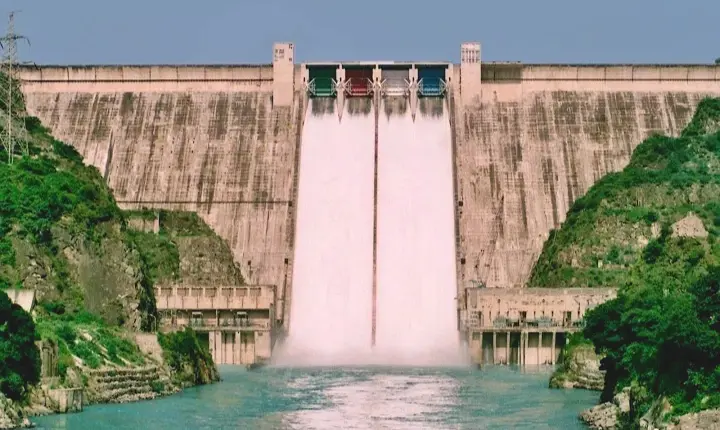
New Delhi: An emergency study has been commissioned by the Bhakra Beas Management Board (BBMB) after it was detected that the main wall of the Bhakra dam on the Sutlej river along the Punjab-Himachal Pradesh border is tilting outward beyond permissible limits.
BBMB chairman Manoj Tripathi, however, assured that there is “no immediate threat” to the structure, as reported by Hindustan Times.
“The permissible deflection of the wall under ideal conditions is 1.03 inches. At present, the dam is experiencing a continuous tilt of 1.77 inches,” Tripathi said. “While this is a cause for concern and we want to assess the situation thoroughly, it is a preventative measure to ensure long-term structural integrity. There is no danger.”
Rs 3 crore has been allocated for the study by the Indian Institute of Technology (IIT) Roorkee, with an additional Rs 1.3 crore set aside for foreign consultants.
B S Sonhmar, secretary, BBMB, said that the structural deviation was noticed more prominently last year when water levels almost reached the top of the reservoir and flood gates had to be opened.
“The deflection of the dam has always been a baseline concern, but now, for the first time, we have decided to get a deep study done to know the real scenario,” Sinhmar said.
The study will be led by M L Sharma, who heads the International Centre of Excellence for Dams (ICED) at IIT-Roorkee. The team is set to start work immediately after signing a memorandum of understanding, which
is expected “very soon”.
“We expect a series of interim reports to guide immediate safety measures as the study progresses, with the final comprehensive report and action plan being submitted within six months to one year,” Sinhmar added.
A decade of unrelenting water pressure and internal siltation is believed to have caused the structural distortion. For the past 10 years, the water level at the dam’s reservoir, Gobind Sagar Lake, has failed to recede to its minimum draw-down level of 1,472 feet. This lack of seasonal relief means the dam wall has been under continuous, unyielding hydraulic stress. At present, the reservoir stands at 1,580 feet-nearly 45 feet higher than the water levels recorded during the same period last year.
Massive sedimentation has compounded the pressure. Commissioned 63 years ago in 1963, the reservoir has lost over 25% of its original 6 billion cubic metres (BCM) capacity to silt, leaving only 4.5 BCM for active water storage.
Underwater mounds of silt rising up to 1,535 feet have formed inside the reservoir, just 10 km from the main dam wall, a senior BBMB official revealed.
Clearing these mounds presents an unprecedented technical and economic challenge. While the BBMB has invited tenders for dredging, disposing of the massive volume of silt away from the reservoir is a logistical nightmare. The board recently approached an Australian agency specialising in deep dredging, but the company expressed its inability to handle silt mounds located in such deep waters.
The situation raises critical concerns for national food security, given its foundational role in India’s Green Revolution. In the early 1960s, Bhakra’s canal network transformed vast tracts of arid northern land into fertile agricultural zones.
The dam enabled an agricultural boom as Punjab’s paddy area surged from 2.27 lakh hectares in the early 1960s to 11.83 lakh hectares within a decade. By 1990, it doubled again, allowing Punjab to fulfil up to 50% of the country’s total rice requirements. The area under wheat also expanded from 14 lakh hectares in the early 1960s to 33 lakh hectares by 1990.