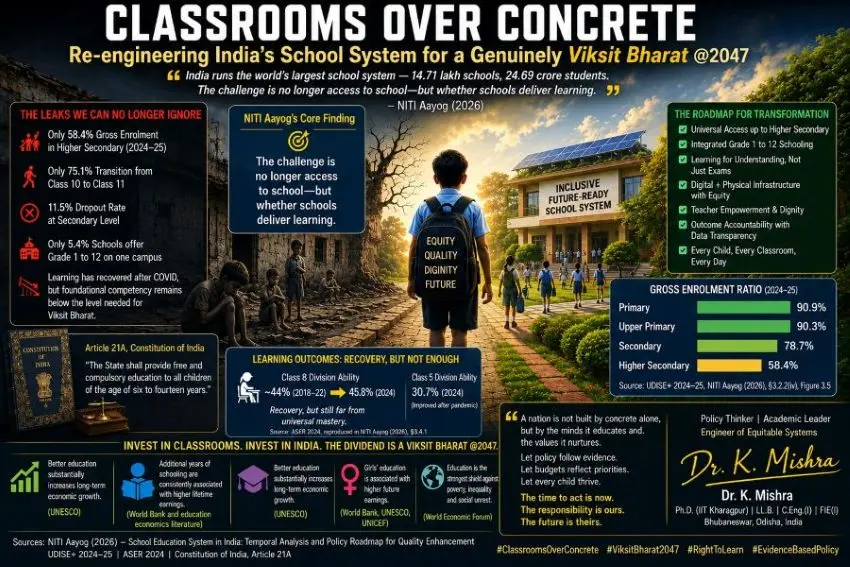
India now runs the largest school system on earth — 14.71 lakh schools, 24.69 crore students. The question NITI Aayog’s own decade-long audit puts to the nation is no longer whether the child can reach a school, but whether the school, once reached, can reach the child.
The scale and the paradigm shift
In May 2026, NITI Aayog released its most comprehensive audit of Indian school education to date — ‘School Education System in India: Temporal Analysis and Policy Roadmap for Quality Enhancement’ — reviewing ten years of data (2014-15 to 2024-25) drawn from UDISE+, the National Achievement Survey (NAS), the PARAKH Rashtriya Sarvekshan 2024, and the Annual Status of Education Report (ASER) 2024. Released by Vice Chairman Suman Bery and CEO Nidhi Chhibber, the report is candid in a way government audits rarely are — it credits real gains in access and infrastructure, and then spends four chapters mapping where the system still falls short.
The headline number is a paradox. Total enrolment has fallen every year since 2021-22 — from 26.52 crore to 24.69 crore. This is not primarily a story of children vanishing from the system. The report attributes it to two structural drivers — a shrinking school-age cohort as fertility rates decline, and a data correction — from 2022-23, UDISE+ began tracking individual students through unique IDs rather than aggregating school-level headcounts, eliminating years of double-counting. Genuine as these explanations are, they should not obscure a second, more consequential trend running alongside them: where a child is educated, and for how long, is changing fast.
GER – Primary 90.9%
GER – Upper Primary 90.3%
GER – Secondary 78.7%
GER – Higher Secondary — 58.4%
(GER is Gross Enrolment Ratio by school stage, 2024-25)
Source: UDISE+ 2024-25, reproduced in NITI Aayog (2026)
Where the system actually leaks
The Gross Enrolment Ratio table above is the clearest single diagnostic in the report. Participation is near-universal through Class 8, then falls away — only 78.7% of the secondary-age cohort and just 58.4% of the higher-secondary-age cohort are enrolled. In plain terms, nearly four in ten adolescents who should be in Classes 11-12 are not — a gap of enrolment and transition, not, as is sometimes loosely claimed in public commentary, a uniform ‘dropout rate’ of that magnitude. The report’s own dropout figures for 2024-25 are more specific, and at the earliest stages tell an improving story: 0.3% at primary, 3.5% at upper primary, rising sharply to 11.5% at secondary — still the system’s most vulnerable stage, but a fraction of some numbers circulating in public debate. The more precise and, arguably, more damning statistic is the transition rate: barely 75.1% of children who finish Class 10 move on to Class 11.
Why does the exit accelerate precisely at secondary level? Two structural reasons stand out.
First, under Article 21A of the Constitution and the Right of Children to Free and Compulsory Education Act, 2009, the guarantee of free schooling extends only to ages 6-14 — secondary and higher-secondary education fall outside this statutory floor, shifting costs onto households exactly when the opportunity cost of a teenager’s labour peaks. Second, and more strikingly, the report finds that only 5.4% of India’s 14.71 lakh schools offer an unbroken Grade 1-to-12 pathway on a single campus. The remaining 94.6% force children to change institutions — sometimes two or three times — between primary and higher secondary; Uttar Pradesh, despite running the country’s largest school network, offers integrated Grade 1-12 schooling in barely 2.9% of its institutions. Every such transition is a fresh opportunity to drop out, particularly for girls, first-generation learners, and children of migrant households.
Learning outcomes: A recovery that hasn’t erased a decade-long slide
This is where the evidence resists a single storyline, and a rigorous reading has to hold two facts together rather than pick the more convenient one. NITI Aayog’s own Executive Summary states that ‘learning outcomes show signs of recovery across grades’ following the pandemic-era collapse, with foundational literacy and numeracy improving in the most recent survey cycle. The underlying ASER 2024 data bears this out at the margin: the share of Class 8 students able to solve a basic division problem rose to 45.8% in 2024 from roughly 44% through 2018-22, and Class 5 division ability, which had fallen during the pandemic years, climbed back to 30.7%.
Set against that short-run recovery, however, is a longer and more troubling decade-scale trend that the report’s own temporal comparison surfaces: the share of Class 8 students able to read a Class 2-level text fell from 74.7% in 2014 to 71.1% in 2024-25. Both facts are true at once — foundational numeracy has edged up since the pandemic trough, while basic reading comprehension among older students has drifted down over the full decade. PARAKH 2024 diagnostics add a further, qualitative dimension: middle-stage students frequently perform adequately on routine textbook recall but struggle to apply the same concepts in unfamiliar, real-world contexts. Recovering toward a mediocre baseline, in other words, is not the same as reaching competence — and NITI Aayog’s own prescriptions, extending Foundational Literacy and Numeracy work beyond Grade 3 and shifting assessment ‘from textbook completion to foundational mastery’, amount to a tacit admission that the post-pandemic bounce is not, by itself, sufficient.
Public-to-private enrolment shift
Government schools still educate 49.2% of India’s students across 68.9% of all school campuses, but their enrolment share has slid from 54.3% in 2014-15. Over the same decade, private unaided schools grew their enrolment share from 31.7% to 38.8%, even as the absolute number of government schools fell — from 11.07 lakh to 10.13 lakh — through consolidation and merger of small, under-enrolled institutions under schemes such as Samagra Shiksha and PM SHRI. The report treats this partly as deliberate rationalisation and partly, in its discussion of ‘increased dependency on private education systems and change in perception of government schools,’ as a genuine market response by parents. Both are true simultaneously, and policy must be honest about which part of the shift is engineered efficiency and which is a vote of no confidence that regulation of low-fee private schools has not kept pace with.
The Constitutional architecture none can ignore
Any national push on school quality runs immediately into India’s federal design. Education sits in the Concurrent List — Entry 25 of the Seventh Schedule to the Constitution, inserted by the Forty-second Amendment Act of 1976 — meaning both Parliament and State legislatures may legislate on it, with Union law prevailing in case of conflict. NITI Aayog’s report builds its entire implementation architecture around this constraint: its 33 pathways rest on ‘the Central and State Governments working in close partnership, and local governments playing an active role’, operationalised through new State and District Task Forces on School Quality. No foundational-learning mission, teacher-deployment reform, or school-consolidation drive can be designed in Delhi and imposed uniformly; it must be negotiated state by state, against very different starting points — Delhi and Chandigarh have already reached 100% secondary-to-higher-secondary transition, while Bihar’s higher-secondary GER stood at just 38.1% in 2024-25.
State visions must reconcile with ground reality
This tension between national ambition and state-level delivery capacity is visible in long-term development blueprints too. The Viksit Odisha @2036 & @2047 vision document, unveiled by the Prime Minister on 20 June 2025 as a joint exercise between NITI Aayog and the Government of Odisha, targets raising the state’s per capita income from roughly USD 2,200 today to USD 9,000 by 2036 and USD 28,000 by 2047, underpinning an economy scaling toward USD 1.5 trillion.
These are legitimate, ambitious targets. But an economy of that scale cannot be built on a workforce drawn from a school system where, nationally, fewer than half of Class 8 students can reliably divide, and where secondary-to-higher-secondary transition in several districts still lags the national average of 75.1%. The lesson generalises well beyond Odisha — every state’s ‘Viksit’ vision document is, whether it says so explicitly or not, a wager on the classroom outcomes this NITI Aayog report documents. Income targets and learning targets are not two separate conversations; they are the same conversation, told twice.
What the roadmap actually recommends
To its credit, NITI Aayog does not stop at diagnosis. Chapter V sets out 13 recommendations — eight systemic, five academic — backed by 33 implementation pathways and more than 125 measurable Performance Success Indicators. The priorities most directly aimed at the fault lines above:
Reform Pillar & Mechanism
Structural continuity: Consolidate standalone schools into composite Grade 1-12 campuses or ‘school complexes’ clustering 5-10 primary schools around a central secondary hub, directly targeting the 5.4% integration gap.
Teacher deployment and career progression: Correct vacancy-driven pupil-teacher ratio distortions and build structured, continuous professional development in place of ad hoc in-service training.
Assessment reform: institutionalise competency-based evaluation through PARAKH so ‘textbook completion’ no longer substitutes for verified mastery.
Targeted equity spending: Direct resources toward the states and districts — Bihar, Jharkhand, Meghalaya, parts of the North-East — where GER, transition, and dropout indicators diverge most sharply from the national average.
State and District Task Forces on School Quality: Institutionalise the Centre-State-local coordination that Entry 25 of the Concurrent List makes legally unavoidable, rather than leaving it to informal consultation.
The Verdict
India has, in a decade, gone a long way toward solving school access: electricity now reaches 91.9% of schools, up from 55.96% in 2014-15; primary and upper-primary participation are close to universal. What remains unresolved is retention beyond Class 8 and the conversion of years spent in school into durable, transferable competence — a recovery in numeracy that has not yet closed a longer decline in reading. As the report itself puts it: ‘As India prepares to commemorate 100 years of Independence in 2047, its progress will not be measured by the number of schools or students in a classroom, but rather by what happens inside those classrooms’. Viksit Bharat @2047 will not be decided by how many schools India built, or even by how many children walked through their gates. It will be decided, quietly and unglamorously, by whether the child who enters Class 1 this year is still learning — not merely still enrolled — by the time she reaches Class 12. On the evidence NITI Aayog itself has now assembled, that outcome remains open.
(Views expressed by the columnist are personal and do not necessarily reflect the opinion or policy of the news portal)