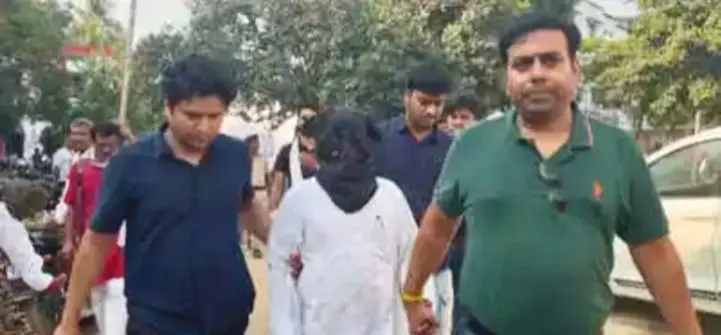
New Delhi: Agencies investigating a radicalisation network with Pakistan-links, stretching across several Indian states, have arrested a key operative from a village in the Madhubani district of Bihar.
Maulana Izhar-Ul-Haq, a teacher at a local madrasah and a resident of the Nautol Sarisabpali village in the Pandaul police station area was picked up in a joint operation by the Madhya Pradesh Anti-Terrorism Squad (ATS) and Bihar ATS on Monday.
Izhar was not merely another member of the network, investigators say. They suspect that he functioned as the “Amir”, the ideological guide and commander, of a group that was allegedly identifying, radicalising and mentoring individuals across different states with the objective of turning them into potential “lone wolf” attackers.
He is said to have remained in regular contact with overseas handlers and was tasked with rebuilding sleeper cells, coordinating finances and expanding the network’s reach. A local court has granted the MP ATS transit remand to take him to Bhopal.
His interrogation at Bhopal could prove crucial in understanding the recruitment and radicalisation process allegedly being used by the network, a senior ATS official told NDTV.
“One of the key reasons why Izhar is important is that he comes from the Seemanchal region. We want to understand how he motivated people, how potential recruits were identified, what kind of individuals were targeted and how they were gradually drawn into the network,” the official said.
Preliminary examination of mobile phones seized during the operation has reportedly revealed indications of communication with numbers based in Pakistan and Afghanistan. Security agencies are now attempting to establish how the alleged network functioned, who coordinated its activities, and how many individuals may have been connected to it.
It all began on June 12 when the Madhya Pradesh ATS conducted a covert operation in the narrow lanes of Old Bhopal and arrested 35-year-old Mohd Faraz near Nanhe Bi’s Mosque in the Qazi Camp area. Sources say the operation was executed with such confidentiality that even local police personnel were unaware until after the arrest had been made.
Faraz, who worked at a doctor’s clinic, soon became the focus of a far-reaching terror investigation. ATS officials al
lege that he was consuming extremist material circulated by foreign handlers and had become deeply radicalised through encrypted online channels.
Investigators recovered alleged jihadi literature, including PDF documents, during initial examination of his digital devices. The agency also began probing whether Faraz was acting independently or as part of a wider, organised network operating across state boundaries. What heightened security concerns further were intelligence inputs suggesting that he was allegedly preparing to travel to Afghanistan for specialised training.
Investigators also discovered that he had reportedly been undergoing martial arts training, a development that raised fears about possible operational preparation.
Investigators soon realised that the trail extended beyond MP. A day after his arrest, officials picked up 38-year-old Naeem Abdullah Qureshi from Nanauta in Uttar Pradesh’s Saharanpur district. According to ATS sources, Qureshi and Faraz had studied together at a madrasah in Deoband, and investigators suspect he played a key role in introducing Faraz to the alleged radical network.
The crackdown widened further on Sunday when the MP ATS, working alongside Rajasthan Police, arrested 34-year-old Mohammad Shakir Mev from Alwar district near the Rajasthan-Haryana border.
Izhar’s arrest from Bihar has now strengthened suspicions that the network may have had a structured leadership hierarchy.
Investigators have also received information suggesting that another accused Naeem allegedly shared photographs and videos of certain locations in Uttar Pradesh with contacts based in Pakistan, sources told the channel.
Investigators believe the alleged module was being guided by a handler operating from Pakistan. According to ATS sources, the handler remained in touch with individuals located in different parts of India and allegedly worked to ideologically radicalise them through online communication.
Most members of the alleged network had never physically met each other, investigators have come to know. Instead, they remained connected through encrypted communication platforms, including WhatsApp and Telegram. However, investigators have learned that Naeem had travelled to Bhopal on one or two occasions and had personally met Faraz.
An examination of Faraz’s mobile phone has yielded what investigators describe as important leads. According to ATS sources, evidence recovered from the device suggests that he was using a specialised application to communicate with foreign contacts.
Faraz had allegedly been assigned the operational name of Khalid Saifullah, a reference to a slain Pakistani Lashkar-e-Taiba terrorist accused in multiple major attacks in India, investigators said. They suspect the alias was intended to inspire recruits and create a sense of ideological continuity with past terrorist figures.
Investigators now believe that Izhar’s interrogation will provide further leads.