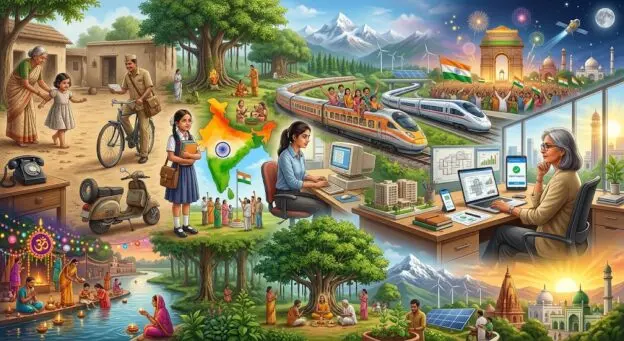
As India celebrates her 80th Independence Day, I find myself looking back, not only at the journey of my country, but also at my own.
I was born in August 1966, when India was only nineteen years into her journey as an independent nation. In many ways, my childhood and my country’s youth grew together. As I learnt to walk, she was learning to stand firmly on her own feet. As I entered school, she was discovering her confidence. As I stepped into my professional life, she too was opening new doors to opportunity.
For sixty years, I have watched India not merely as a citizen, but as a fellow traveller.
My friends from other countries often ask me, “What is the greatest change you have witnessed in India?”
My answer sometimes surprises them.
It is not a highway.
Not an airport.
Not a digital payment.
Not even a spacecraft reaching the Moon.
The greatest transformation I have witnessed is something far deeper.
India has refused to stop evolving.
That, to me, is her greatest strength.
When I was a child, communication travelled slowly. A letter took days and months to arrive. A telephone call was a luxury. Owning a scooter was a matter of pride, and a train journey was an event the whole family looked forward to.
Today, money moves across the country in seconds. A student in a small village can attend a lecture delivered anywhere in the world. Entrepreneurs can build businesses from a laptop. Our scientists explore space, our engineers build world-class infrastructure, and our young people compete confidently on global platforms.
The transformation has been extraordinary.
Yet what inspires me most is not the speed of change. It is our ability to change without completely losing ourselves.
Even as our cities have grown taller, lamps are still lit before new beginnings. Even as technology connects us instantly, millions still gather for festivals(Dusserah,Diwali,Holi etc.) with the same joy their grandparents knew.
And somewhere within these traditions lies another wisdom that I appreciate more deeply as I grow older,our relationship with nature.
For generations, we have called our rivers mothers. Ganga, Yamuna, Saraswati, Narmada, Kaveri and countless other rivers are not merely water bodies in our cultural consciousness; they are revered as life-givers. We bow before the Sun that gives us light and energy. Trees are considered sacred. Tulsi finds a place of reverence in our courtyards, and the Peepal and Banyan have been protected and worshipped for generations. Mountains, forests, animals, the earth beneath our feet and even the celestial bodies above us have found a sacred place in our traditions.
Perhaps our ancestors understood something that the modern world is having to rediscover today: we protect more naturally what we learn to revere.
When a river becomes a mother, polluting her should trouble our conscience. When a tree becomes sacred, cutting it unnecessarily becomes more than the loss of timber. When forests and mountains become part of our spiritual imagination, conservation ceases to be merely a government programme,it becomes a personal responsibility.
Of course, reverence alone is not enough. Our generation must translate that ancient respect into modern environmental responsibility. We cannot worship our rivers and allow them to become polluted. We cannot celebrate trees in our traditions and remain indifferent to disappearing green cover. The wisdom we inherited must find expression in the way we live today.
To me, that too is India,ancient wisdom continuously asking to be interpreted for contemporary times.
At the same time, temples continue to welcome devotees, gurdwaras continue to serve free meals, mosques continue to call the faithful to prayer, churches continue to ring their bells, and countless homes continue to teach children that respect, compassion and gratitude matter.
Some call this contradiction.
I call it India’s genius.
A civilisation survives not because it refuses change, but because it knows what should never change.
During these sixty years, India has celebrated remarkable achievements. Economic reforms expanded opportunity. Digital public infrastructure transformed the way millions access financial services and government benefits. Infrastructure has connected regions once separated by distance. Scientific achievements have strengthened our confidence. Entrepreneurs have demonstrated that global innovation can emerge from Indian soil.
Each of these milestones deserves recognition.
But policies alone do not define a nation.
Policies belong to a generation.
Values belong to a civilisation.
Governments come and go.
Technologies evolve.
Economies rise and fall.
Yet a nation endures when its people continue to believe in hard work, learning, compassion and hope.
As an entrepreneur, I have learnt that no organisation survives by repeating yesterday’s successes. Every institution must adapt, innovate and renew itself. The same is true of nations.
Standing still is never an option.
Progress demands courage.
Adaptation demands humility.
Growth demands continuous learning.
Looking back, I realise that my own journey has quietly mirrored my country’s.
As I built businesses, India built institutions.
As I learnt to trust young professionals with responsibility, India trusted its youth to shape the future.
As I discovered that leadership is about creating opportunities for others, India too expanded opportunities for millions who had long remained outside the mainstream of growth.
Perhaps that is why I have never viewed my country’s progress merely as newspaper headlines. I have experienced it as part of my own life.
The India of my childhood, the India of my youth, the India in which I became an architect and entrepreneur, and the India I see today are remarkably different-and yet unmistakably the same India.
Many people search for one decision, one leader, one policy or one moment that changed India’s destiny.
I think differently.
No single decision transforms a nation forever.
What transforms a nation is its collective willingness to keep moving forward while remaining rooted in enduring values.
That is the lesson India has taught me.
She has shown me that strength is not rigidity.
Strength is the ability to evolve without losing one’s soul.
As I complete sixty years of my own journey, I look at my country with gratitude.
She has taught me resilience without bitterness.
Confidence without arrogance.
Ambition without forgetting compassion.
Modernity without abandoning heritage.
Progress without forgetting our responsibility towards nature.
And above all, she has taught me that every sunrise offers another opportunity to become better than yesterday.
If there is one lesson I wish to leave for the next generation, it is this:
Never become so successful that you stop evolving.
That is true for an individual.
It is true for an institution.
And it is equally true for a nation.
India’s greatest achievement is not simply that she has changed. It is that after thousands of years of history, she still possesses the courage to become a better version of herself without losing her soul.
As we celebrate our Independence Day, perhaps our tribute to India should not remain confined to pride in what she has achieved. It should also become a promise to keep learning, keep building, keep contributing and keep evolving; to preserve our rivers, forests, mountains and natural heritage; and to hold firmly to the values that have sustained this civilisation through centuries.
At sixty, when I look back at the country that grew alongside me, I feel gratitude, pride and, above all, hope.
Mera Bharat Mahaan.
Not because she is perfect.
Not because her journey is complete.
But because despite every challenge, every setback and every contradiction, she has never stopped striving to become better.
And perhaps true patriotism lies there too-not only in celebrating the greatness of our country, but in accepting our own responsibility to make her greater.
May we, her children, have the courage and wisdom to do the same.