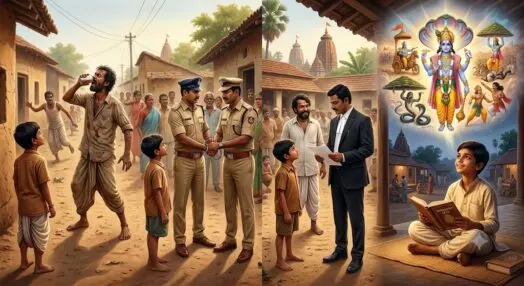
Children often dream of becoming doctors, engineers, IAS officers, or IPS officers. My childhood dream, however, was rather unusual—I wanted to become a roaring drunkard.
I must have been in Class IV or V then.
I grew up in Belaguntha, a small village in Odisha’s Ganjam district. In those days, our village had a thriving country liquor shop. Popular brands such as Aska 20 and Aska 40 were sold there. (Aska, now known as Asika, was home to one of Odisha’s earliest sugar mills and distilleries, supplying liquor across much of the district.)
Among the regular customers was a man named Raghu Behera.
Raghu seemed incapable of beginning his day without a drink. By morning, after several glasses of country liquor, he would stride through the village like an emperor. He shouted abuses at anyone who crossed his path, and people quietly stepped aside to avoid provoking him.
As a child, I misunderstood fear for power. Watching everyone make way for Raghu, I concluded that he must be the most powerful man in the village. I secretly wished that one day I, too, could command such fear, that people would move aside wherever I went, and no one would dare question me.
Then one morning, Raghu disappeared.
The village seemed strangely quiet.
Curious, I asked my father where Raghu had gone.
“The police arrested him,” my father replied. “They have put him in jail.” I was stunned.
How could anyone arrest Raghu?
Until then, I had believed that no one was stronger than him. That day, I discovered that the police were even more powerful. Instantly, I abandoned my dream of becoming a drunkard and decided that I would become a police officer instead.
A few days later, Raghu returned.
He was exactly the same as before-walking with swagger, shouting abuses, and terrifying the neighbourhood.
Confused, I again turned to my father.
“How did the police let him go?”
“They didn’t,” my father smiled. “A lawyer named Sabat got him bail.”
I had no idea what bail meant, but I understood one thing: if a lawyer could get someone released from police custody, then surely a lawyer was even more powerful than the police.
Without wasting another moment, I revised my life’s ambition once again.
Now I wanted to become an advocate.
That dream stayed with me for several years.
Then another influence quietly entered my life.
Every evening, our family gathered to read scriptures such as the Ramayana, Mahalaxmi Purana, Nrusingha Purana, and the Bhagavad Gita. One day, while reading the Bhagavad Gita, I became fascinated by the stories of Lord Krishna.
I was probably in Class VI.
From that day onwards, I began reading a chapter of the Gita every day. I was mesmerised by Krishna’s extraordinary life.
He defeated the demon Putana in infancy, uprooted the twin Arjuna trees, subdued the mighty serpent Kaliya, lifted Govardhan Hill on his little finger to protect his people, destroyed the tyrant Kansa, and later became the wise charioteer who guided Arjuna through the great war of Kurukshetra.
Every story seemed larger than life.
Whenever I found time, I returned to those chapters, reading them again and again until parts of them became etched in my memory.
Krishna completely captured my imagination.
To me, he possessed every quality that mattered. He was fearless, intelligent, compassionate, mischievous, strategic, and irresistible. He defeated evil not merely through strength, but through wisdom. I constantly questioned my father about Krishna, trying to understand every aspect of his life.
Gradually, I arrived at what I thought was my final conclusion.
If there was one person who embodied true power, it was Lord Krishna.
I wanted to become like him, not because I wished to dominate others, but because I believed that, like Krishna, I could protect those I loved, defeat injustice, and never allow anyone to intimidate me.
That became my final childhood dream.
My Learnings-
Looking back today, I smile at how my definition of power kept changing.
First, I thought power meant making people afraid.
Then I believed it lay in wearing a police uniform.
Later, I imagined it resided in the courtroom.
Finally, I discovered it in the life of Lord Krishna.
Perhaps that is what childhood really is a series of beautiful misunderstandings, each one preparing us for a deeper understanding of life.
As children, we admire those who appear powerful. As adults, we slowly learn that true power lies not in making others fear us, but in mastering ourselves.
(Views expressed by the columnist are personal and do not necessarily reflect the opinion or policy of the news portal)