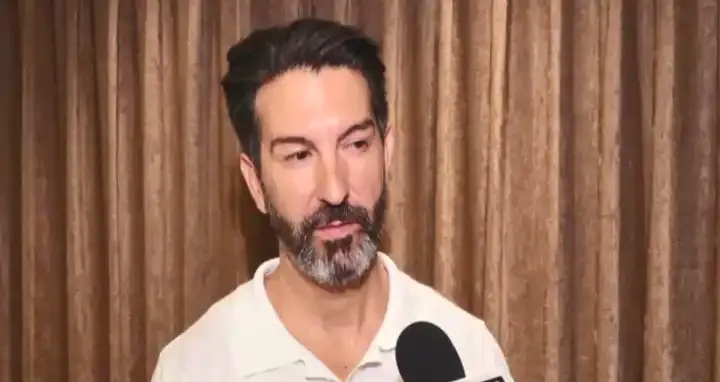
Tel Aviv: A major global cooperation between India and Israel is required to counter the “Eighth Front” of information warfare, former Mossad agent Sagiv Asulin said, while highlighting the growing challenge of narrative manipulation.
Israel views India as a key strategic and value-based partner, Asulin told ANI, noting that the two nations are uniquely positioned to join forces against non-kinetic threats emerging through social media, which primarily target the younger generation.
The “Eighth Front” represents a modern strategic concept that encapsulates the battle over narratives and information. It functions as a critical contest for global perception, digital media dominance, and international diplomatic alignment.
This specific dimension stands apart from conventional military engagements, within the framework of regional tensions involving Israel. It presents a fundamental challenge that plays out across academic institutions, major news outlets, and various virtual channels.
Asulin drew parallels between these global perception threats, highlighting the propaganda battles faced by Israel and the information warfare targeted against India following its own recent military actions. Specifically, he drew comparisons to the narrative battles that emerged after India’s ‘Operation Sindoor’.
Just as India faced intense external information warfare surrounding these events, the former intelligence agent noted that both nations face identical perception battles.
“I think that Israel and India, you know, the only Jewish democracy and the biggest democracy worldwide, India, are great allies. Israel sees India as a strategic partner, not just, mainly, I think, values-wise.” Asulin said, underlining the deep bilateral and intelligence-sharing ties between the two democracies.
Israel has historically shared, and will continue to share, its best intelligence to counter any threats facing India, he said.
Expanding on the nature of modern conflict, he warned that public perception has effectively become a critical battlefield, driven by an alliance of radical and ultra-left ideologies.
“If you’re talking about the threats that are coming from the Eighth Front, so the Eighth Front is the front for public perc
eption, the front for the truth,” Asulin explained, adding: “This is something that is coming both from radical Islam and from the ultra-left woke progressive movement. We see that in America. We see that in Europe. We see that in India. We see that also in Israel.”
He pointed to the aftermath of the October 7, 2023, attacks in Israel, to further illustrate how these perception battles intertwine with real-world crises. This assault sparked a conflict that has now persisted for over two years.
The hostilities began when Hamas launched an attack resulting in the deaths of approximately 1,200 individuals and the capture of over 250 hostages.
The subsequent military actions have led to massive devastation. The Palestinian Health Ministry in Gaza reports that over 72,700 Palestinians have been killed since the hostilities broke out.
Asulin clarified that the issue was rooted in analytical paradigms rather than a lack of information while addressing the intense scrutiny and intelligence gaps surrounding the initial October 7 failures, . He explained that Mossad’s mandate is strictly restricted to operations outside Israel.
“So, Mossad is not working on Gaza or Judea and Samaria, the West Bank, only outside Israel. It’s not, that’s not something that, you know, changes the situation because eventually it’s Israel and absolutely was a major intelligence failure. Those things are still under investigation, and I believe that we’ll have a lot of small details that we will understand about what went wrong and how,” Asulin said.
He conceded that it was a major intelligence failure, and said that the core breakdown was systemic rather than a lack of data.
“But it’s not an intelligence failure because I think it was not a lack of intelligence. It was the paradigm of October 7, the conception of October 7, of us focusing mainly on the northern part of Israel and Iran and undermining the threat from Gaza, Hamas, Palestinians,” Asulin explained.
“It’s not a lack of information or intelligence, so it’s how you are analysing the intelligence that was received, and this is, that’s the main gap, being honest on that,” he added.
The former intelligence operative floated the idea of an institutionalised mechanism to counter coordinated disinformation campaigns, advocating a centralised effort between allied nations as these analytical gaps and subsequent narrative wars are global in nature.
“I think that… it’s actually not a bad idea to start with an organisation that first of all will be here in Israel, but every nation, I think, needs to have something like that,” Asulin said, adding, “Since this is a global threat from global enemies that tackle the same countries, so there should at least be major cooperation between countries, but in the future to have one organisation that will lead the fight against this threat is a very fine, good idea for that.”