New Delhi: The INDIA bloc on Saturday unanimously approved a resolution demanding the removal of Chief Election Commissioner Gyanesh Kumar, alleging that he was part of a “devious and malevolent criminal conspiracy orchestrated by the BJP to steal national and state elections” and calling for him to be prosecuted for treason.
Congress president Mallikarjun Kharge announced the resolution at the Opposition’s symbolic “public impeachment” programme in New Delhi. It levelled six accusations against Kumar, covering suspected interference with voter rolls, changes to registration procedures without Parliament’s approval, and alleged compliance with Prime Minister Narendra Modi and Union Home Minister Amit Shah.
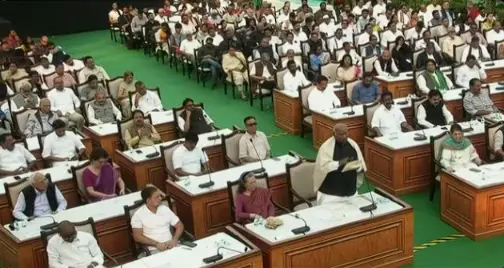
Opposition parliamentarians, party functionaries and civil-society activists endorsed the resolution by a show of hands at an unprecedented gathering chaired by former Lok Sabha Speaker Meira Kumar on the lawns of Kharge’s 10, Rajaji Marg residence.
Kharge proposed the resolution, Samajwadi Party MP Harendra Malik backed it, and Rahul Gandhi, the Leader of the Opposition in the Lok Sabha, joined several other Opposition figures in supporting it.
Leaders and representatives from at least 18 parties were present, as were Independent Rajya Sabha member Kapil Sibal and individuals who claimed they had been wrongly removed from voter lists.
The gathering took place ahead of the bloc’s march and public rally in Delhi, part of its push against alleged poll irregularities and the Special Intensive Revision (SIR) of electoral rolls, as reported by The New Indian Express.
Accusations Against Gyanesh
In its first accusation, the bloc said Kumar had supervised and taken part in a “devious and malevolent criminal conspiracy orchestrated by the BJP to steal national and state elections”.
It also claimed that Kumar had “willingly broken the rule of law by allowing them to access voter rolls, to delete and add voters at will and manipulate the outcome of the elections”.
“He is guilty of operationalising a premeditated attack on the electoral process that is the very foundation of India’s democracy. This is a criminal act and an act of treason against the nation and the Constitution of India,” the resolution said.
The second accusation said Kumar was directly answerable for what the Opposition called a manipulated and harmful SIR process, which it claimed had intentionally removed 13.2 crore voters and taken away their constitutional voting rights.
According to the resolution, these deletions were made in a biased and secretive manner, breaching natural justice.
The third accusation dealt with suspected revisions to Form 6 under the Registration of Electors Rules, 1960. The bloc alleged that Kumar changed the form without Parliament’s knowledge or supervision to stop new, first-time voters from registering.
It described the alleged step as a “criminal conspiracy to prevent the enrollment of first-time voters and stealing from them the fundamental right to vote guaranteed by the Constitution, effectively negating their rights as citizens of India”.
The fourth accusation said Kumar had gathered control of electoral rolls through ERONET/ECINET software. The Opposition claimed the system was being used to strike off voters and block local Electoral Registration Officers (EROs) from enrolling valid names.
“This is a criminal attempt to tamper with the process of free and fair elections upon which the democratic framework of India is founded. It is an act of treason against the nation and the Constitution of India,” the resolution said.
The fifth accusation alleged that Kumar had kept the other two Election Commissioners away from decision-making. The bloc said he and seven Election Commission associates broke the law by deliberately excluding them.
It said the two commissioners had recorded at least 14 objections, and called their exclusion a violation of the Commission’s constitutional role.
The sixth accusation said Kumar violated his constitutional obligation to remain independent and safeguard free and fair elections. The Opposition claimed he refused it a fair hearing and followed directions from Modi and Shah.
The resolution further alleged that some of Kumar’s relatives had benefited through “plum postings and unprecedented opportunities for remuneration” because of his “shameful compliance with the ruling BJP”.
It said the CEC had “brazenly” violated his constitutional duty at the behest of the Prime Minister and Home Minister, betraying people’s confidence.
Protection Law Attacked
The bloc also attacked the legal cover available to the CEC under the Chief Election Commissioner and Other Election Commissioners (Appointment, Conditions of Service and Term of Office) Act, 2023.
It claimed the provision was meant to prevent Kumar from being held accountable, alleging that the “lifelong legal protection provided to Chief Election Commissioner Kumar by Prime Minister Narendra Modi’s government in December 2023 was intended as a cover for the criminal activities enacted by him against the nation and the Constitution of India”.
The bloc sought Kumar’s immediate removal and said he must be tried under constitutional procedures.
The resolution concluded: “The Members of Parliament of the INDIA Janbandhan representing over 60% of the population of India and citizens assembled in New Delhi on October 31, 2026, resolve that for this gross betrayal of the people of India the Chief Election Commissioner, Mr. Gyanesh Kumar, must be tried for treason in a court of law in accordance with the legal framework of the Constitution of India.”
‘No Accountability’
Meira Kumar, who began the proceedings, said the meeting was organised because genuine voters were being “wrongfully” taken off electoral rolls and the INDIA bloc received no accountability when it raised the matter.
“When this issue is raised by the INDIA bloc, there is no accountability. So we have decided that the INDIA bloc will hold a meeting and bring a proposal to remove Gyanesh Kumar,” she said.
The stage was modelled on the former Lok Sabha chamber, complete with a wooden-panelled backdrop, seats placed in a semi-circular layout, and microphones fitted in the first three rows so members could speak from their seats.
Samajwadi Party MP Awadhesh Kumar and Trinamool Congress MP Saugata Roy served as deputy presiding officers.
Rahul Gandhi, supporting the resolution, called the symbolic “public impeachment” an “extremely dangerous political weapon” aimed at those who, according to him, had joined hands to destroy the votes of Indians.
“I fully support the motion to impeach Gyanesh Kumar, who should be tried for treason in court and justice should be served,” Gandhi said while closing the event.
He asserted that Kumar would “not survive as the CEC” and said the Opposition had sufficient evidence to prevent him from staying in office.
“We have enough evidence to ensure that this gentleman does not continue in office. If the BJP insists on retaining him even after we reveal what we know, then its game will be clear for everyone to see,” he said.
Gandhi said the gathering was a political weapon directed at Kumar, Modi and Shah, whom he accused of working together to destroy Indian votes.
Other Opposition leaders and civil-society representatives also addressed the meeting. CPI(M) leaders said the CEC had damaged universal adult franchise through SIR and no longer had the moral or legal right to hold office.
Trinamool Congress leader Sagarika Ghose alleged that the 2026 West Bengal Assembly elections had been “stolen” by removing eligible voters, and accused Kumar of acting with the central government to defeat the people’s mandate.
‘Mukhya Chunav Abhiyukt’
Swaraj Abhiyan chief Yogendra Yadav called Kumar the “Chief Election Culprit”, saying in Hindi that he was not “Mukhya Chunav Ayukt” but “Mukhya Chunav Abhiyukt”.
CPI MP Sandosh Kumar, TMC MP Mahua Moitra, CPI(ML) Liberation MP Sudama Prasad, Independent MP Kapil Sibal and AISA president Neha Bora also spoke, along with civil-society members and people who said their names had been wrongly deleted during SIR.