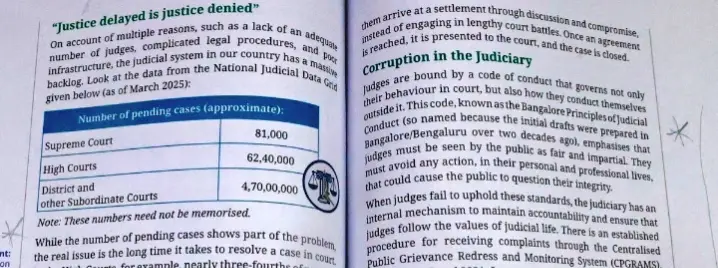
New Delhi: The Supreme Court, on Friday, recalled its earlier order that had blacklisted three academics for their role in drafting a chapter on “Corruption in the Judiciary” for a Class-VIII NCERT textbook.
The Court also expunged the adverse observations made in its March 11 order, in which it had accused the three academics of deliberately misrepresenting facts to project a negative image of the Indian judiciary before Class 8 students.
The bench of Chief Justice of India (CJI) Surya Kant, Justice Joymalya Bagchi and Justice Vipul M Pancholi expressed satisfaction with the explanation offered by the three and allowed central and state institutions to independently decide on associating with them in academic projects, as reported by Deccan Herald.
The academics, who had expressed concern over the far-reaching consequences of the earlier order on their professional careers, told the Court that the chapter was prepared through a collective decision and without any malice.
After going through applications filed by the three, the bench made it clear that the Union government and state governments are free to take their own decisions regarding future association with these experts.
On March 11, the Supreme Court had directed the Centre and all states to disassociate from the three academics – Michel Danino, Alok Prasanna Kumar, and Suparna Diwakar – citing the “offending” content in the textbook.
On February 26, the top court had imposed a complete ban on the publication, reprinting, or digital dissemination of the textbook.
Appearing for Danino, senior advocate Shyam Divan argued that the March 11 order was passed without hearing the academics and that the content was not a case of individual authorship but a collective decision of the committee.
Kumar was represented by senior advocate Gopal Sankaranarayanan, who submitted that the Class 8 chapter was a continuation of topics covered in Classes 6 and 7.
Students should be given a realistic understanding of institutions, including their shortcomings, rather than a “white-washed” version, he contended.
“There is open discussion in the media about issues affecting the judiciary. These cannot be suppressed from students,” Sankaranarayanan argued, adding that there was no malicious intent and that open discussions were necessary for finding solutions.
Diwakar’s counsel senior advocate J Sai Deepak highlighted that his client had only a limited role in the drafting and that the order severely affected their right to livelihood.
The issue was whether the presentation was balanced, the Court pointed out.
“Corruption was highlighted as a unique feature of the judiciary. Not a single word about access to legal services or the positive role of judges,” it observed.
Other portions of the book did discuss the contributions of the judiciary, the academics said.
The court accepted the academics’ contention that they were not “fly-by-night” operators but individuals with established credibility. It withdrew the blacklisting order, noting that the explanation offered was satisfactory.