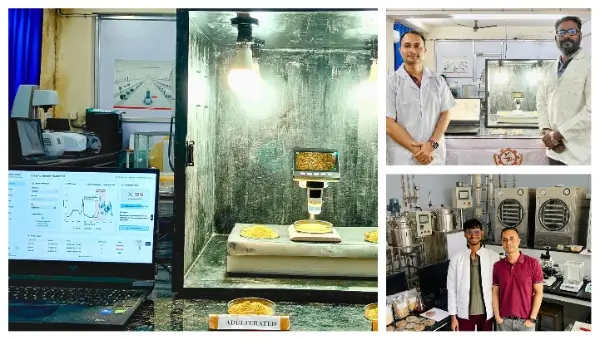
Rourkela: Researchers at the National Institute of Technology (NIT) Rourkela have been granted a patent for an innovative system that can quickly detect and measure the level of adulteration in spices and other food products.
Spice adulteration, often motivated by cost-cutting measures, compromises food quality and poses potential health risks to consumers. Traditional detection methods, such as chromatography and molecular techniques, are time-consuming, expensive, and require significant resources, making them impractical for routine or real-time testing.
In contrast, the newly patented technology delivers results in seconds and provides precise quantification of adulteration levels. The system integrates Fourier Transform Infrared (FTIR) spectroscopy — a technique that analyses how materials absorb infrared light — with advanced machine learning models.
By capturing spectral patterns from food samples and processing them through these models, the technology identifies complex, non-linear irregularities associated with adulterants, enabling fast and accurate measurements. It is non-destructive, cost-effective, and designed for real-time use in quality control laboratories and industrial processing units.
The research, led by Assistant Professor in the Department of Food Process Engineering Sushil Kumar Singh, along with the late Prof Poonam Singha and MTech graduate Rishabh Goyal, has been published in the prestigious journal Food Chemistry.
The team secured Indian Patent for the invention titled “Method and System for Detecting and Quantifying Adulteration in Food Stuff.”
In one key application highlighted in the study, the system was tested on coriander powder adulterated with sawdust, a common and concerning practice. The machine learning-integrated FTIR approach achieved approximately 92% accuracy in detecting and quantifying this adulteration. The research also outlined a broader methodological framework that can be extended to identify various adulterants in different food products.
“Our invention addresses a long-standing gap in the food industry — the lack of a fast and reliable spice adulteration detection system. By combining rapid FTIR equipment with novel machine learning approaches, we have created an integrated system with strong decision-making capabilities. This will help ensure food safety, support regulatory compliance, and build greater consumer trust across the supply chain,” Prof Singh said, emphasising the practical value of the innovation.
He further stated that the technology is particularly well-suited for Indian food companies processing spices at any stage, from raw materials to finished products.
“It can be seamlessly integrated into existing quality control workflows for real-time decision-making, making it ideal for routine screening. Its scalability and cost-effectiveness give it strong potential for adoption by both large industries and small and medium enterprises (SMEs),” he added.
Unlike conventional lab-based methods that involve extensive manpower, chemical reagents, and long processing times, the NIT Rourkela system eliminates complex sample preparation, reduces operational costs, and minimises production delays. These advantages are especially significant in price-sensitive markets like India, where affordable and large-scale food safety solutions are urgently needed.
The research team plans to collaborate with industry partners for pilot-scale studies and real-world validation. Future work will also focus on expanding the technology’s capabilities to detect adulteration in a wider range of food products under varying conditions.
As food safety concerns continue to grow globally, this patented innovation from NIT Rourkela is expected to strengthen accountability and public health protection throughout the food supply chain, a release from the institute said.