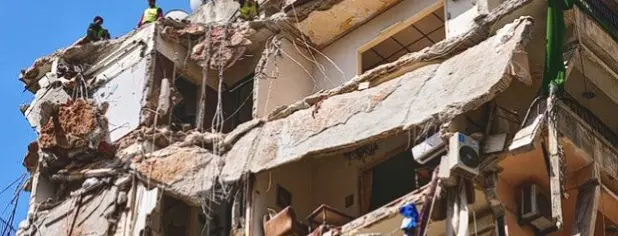
Beirut: Hezbollah leader Naim Kassem called on Lebanon’s government on Monday to abandon direct talks with Israel, slated for Washington on Tuesday in a historic first after decades, even as intense combat unfolded in the border town of Bint Jbeil.
In a televised speech timed just before the ambassadors’ meeting to outline negotiation terms, Kassem spoke out amid renewed hostilities. These stemmed from Hezbollah rocket attacks on northern Israel starting March 2, retaliation for US and Israeli assaults on Iran, Hezbollah’s main supporter.
The Health Ministry reports 2,055 deaths from Israeli strikes in Lebanon, including 252 women, 165 children, and 87 medical workers, with 6,588 wounded and more than 1 million displaced.
Lebanon’s government — vowed to stripping Hezbollah of weapons — sought direct talks from the war’s outset: Israel endorsed them last week, but core demands differ, with Lebanon insisting on an initial ceasefire like the Pakistan-mediated Iran-US process, while Israel pursues comprehensive peace negotiations focused on Hezbollah’s disarmament, omitting any truce or southern Lebanon withdrawal.
“We refuse negotiations with the Israeli entity. These negotiations are pointless,” Kassem stated in the address, deeming them a “free concession” to Israel and the US. “The opportunity is still there. We call for a historic and heroic position to cancel these negotiations.”
He pushed for restoring the ceasefire that ended the 2024 Israel-Hezbollah war through indirect channels involving the US, France, and UN peacekeepers in southern Lebanon.
Kassem assailed the government for outlawing Hezbollah’s armed operations, its diplomatic overtures to Israel — which “did not take us any step forward” — and steps to oust Iran’s ambassador while criminalizing the Iranian Revolutionary Guard’s activities.
“We will let the front line speak,” Kassem said.
Fierce Clashes Grip Strategic Bint Jbeil
Monday’s heavy fighting in Bint Jbeil saw Israeli forces seemingly surround the elevated town overlooking the UN Blue Line by just over 3 kilometers (2 miles), as Hezbollah fighters fired rockets and shells to repel them.
Tensions spiked in the past week post-Iran-US truce, with the US ambassadors’ in-person Washington session set for Tuesday to launch these pivotal direct talks.
Israel curbed strikes in Beirut following unannounced attacks that killed over 350 in crowded residential and commercial zones. Simultaneously, it intensified ground pushes and airstrikes in the south to establish a buffer along the Litani River, nearly 30 kms (18 miles) inland. Bint Jbeil ranks among scores of villages south of the river that Israel urged to evacuate at war’s outset.
Hezbollah’s Wafiq Safa told The Associated Press on Monday: “there are bloody battles that are still being fought until now” in Bint Jbeil, where numerous fighters face encirclement. “So far, this battle has not ended. Of course, there are martyrs for us. This is very normal. There are certainly losses to the Israeli enemy.”
Israel’s army reported encircling Hezbollah setups and launching ground raids in Bint Jbeil and vicinity, eliminating more than 100 militants. Hezbollah has not disclosed its losses, nor has Israel detailed its own.
The group claimed five strikes on Sunday at Israeli positions near a school, hospital, and central junction using rockets, artillery, and drones. Israel countered that its forces hit Hezbollah spotters at Bint Jbeil Government Hospital, uncovering machine guns and rockets.
Bint Jbeil held strategic high ground for Israel during its pre-2000 occupation of south Lebanon. Hezbollah’s seizure and then-leader Hassan Nasrallah’s stadium victory address shifted the dynamic. Israeli military imagery released Monday depicted the stadium in ruins from an airstrike.
Prime Minister Benjamin Netanyahu informed his Cabinet on Monday of pushing beyond five 2024 ceasefire hilltops for a “solid, deeper security zone” to safeguard northern Israel.
Red Cross Volunteer Laid to Rest After Fatal Strike
In Choueifat south of Beirut, mourners buried 31-year-old Lebanese Red Cross volunteer Hassan Badawi, killed on Sunday in an Israeli strike during a southern village mission in Beit Yahoun.
Badawi and a colleague headed to a hit house nearby, after UN peacekeepers coordinated clearance with Israel. They traveled in emblem-marked ambulances with flashing lights, helmets, and flak jackets, according to colleagues at the funeral.
“That is the only protection we have,” said paramedic Ahmad Assi, 29, a friend.
Badawi, who studied engineering at Lebanese University with friend Mohammed Cheito a decade ago, often described the chaos: “He said they were bombing everywhere, that he felt stuck, like he had to stay because there were too many wounded people that needed his help.”
A Monday Israeli strike near Tyre Red Cross offices killed a patient in transit and wrecked vehicles; an anonymous source indicated it hit a motorcycle carrying the injured. Identities remain unclear.
The International Committee of the Red Cross demanded safeguards for aid personnel. “Saving lives must never cost a life,” said Lebanon delegation head Agnes Dhur. “They must be allowed to reach and help the wounded and return unharmed.”
Israel’s military offered no immediate reply to AP inquiries.