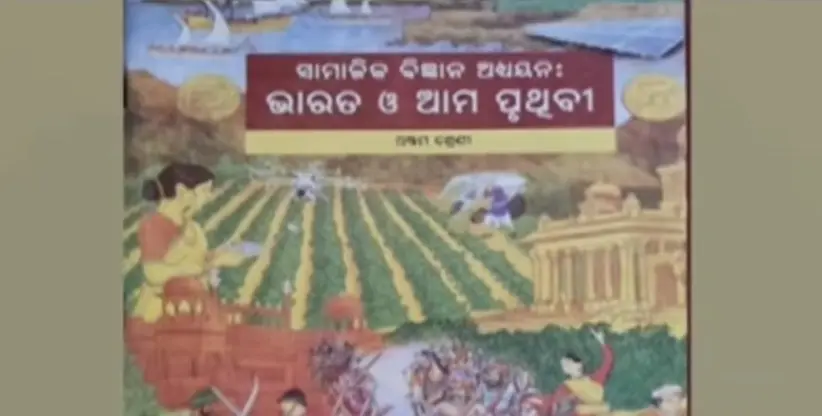
Bhubaneswar: The Odisha government is facing sharp criticism over detection of 1,678 factual, grammatical, typographical, and contextual errors in newly revised school textbooks for Classes I to VIII, introduced for the 2026-27 academic session under the National Education Policy (NEP) 2020 and the state curriculum framework.
In response to a grievance petition filed with the Chief Minister’s office alleging excessive printing costs, the Directorate of Textbook Production and Marketing (TBP&M) clarified that it spent approximately Rs 21 crore on outsourcing a portion of the printing work to private presses. This was necessitated because its in-house facilities could not handle the large-scale order. The directorate firmly denied claims of spending Rs 165 crore on outsourcing.
According to TBP&M, the revised curriculum includes 55 textbooks prepared by the State Council of Educational Research and Training (SCERT), compared to 46 in the previous year. The Odisha School Education Programme Authority (OSEPA) estimate
d a requirement of around 2.28 crore to 2.98 crore books this year, slightly lower or comparable to previous estimates. Many of the new books feature higher page counts and multi-colour printing, significantly increasing the production volume and complexity.
Officials explained that the decision to outsource part of the work was taken with government approval due to operational constraints, following recommendations from a state-level committee meeting on May 21, 2025.
The errors, which include spelling mistakes, factual inaccuracies (such as misplacing Odisha’s Niyamgiri Hills in Jharkhand), incorrect names of personalities, wrong photographs, and swapped images (Karnataka Assembly building for Odisha Assembly, Hampi identified as Konark Sun Temple), were flagged by teachers and a review process.
Class VIII books reportedly accounted for the highest number of 705 errors.
Acting swiftly on the issue, Chief Minister Mohan Charan Majhi ordered the formation of a three-member high-level committee headed by Development Commissioner DK Singh to investigate the lapses, identify responsible officials or agencies, and submit its findings. School and Mass Education Minister Nityananda Gond has also engaged with the panel.
SCERT has acknowledged the errors but ruled out issuing fresh textbooks this academic year. Teachers have been instructed to make corrections manually in classrooms, with fully revised editions planned for the 2027-28 session.
The controversy has drawn criticism from opposition parties, teachers’ associations, and parents, who question the quality control in the rushed curriculum overhaul aligned with national standards.