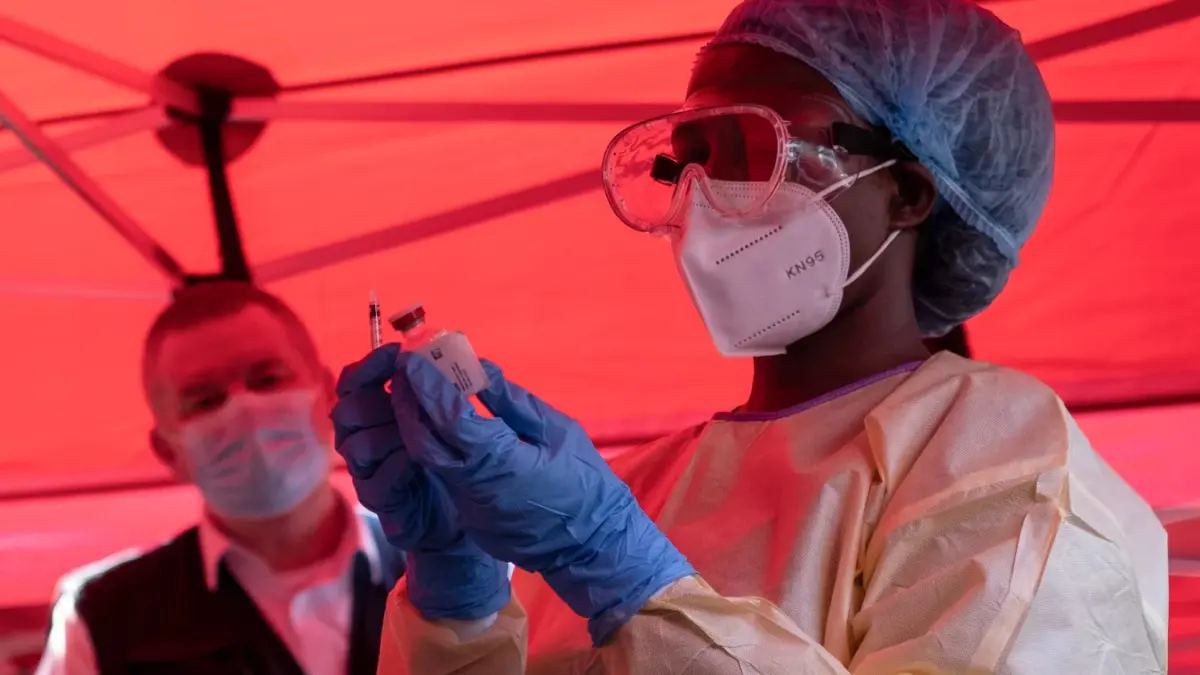
Pune: Six years ago, the world yearned for a vaccine to fight the COVID-19 pandemic, and got more than one within a year.
Now, as the terrifying spectre of Ebola raises its head in Africa, global health agencies are looking to accelerate vaccine development before the outbreak spirals out of control.
The current Ebola outbreak, through the Bundibugyo virus, is a lesser-known strain which has spread in parts of the Democratic Republic of the Congo (DRC) and Uganda.
India’s Serum Institute of India (SII), the world’s largest vaccine manufacturer which played a key role during the coronavirus outbreak in 2020, is once again looking to position itself as a critical player in the race to produce a promising experimental vaccine based on the ChAdOx platform developed with the Oxford University.
According to latest figures released by the governments of DRC and Uganda, 575 suspected cases have been flagged with 51 confirmed infections and 148 suspected deaths linked to the Bundibugyo strain of Ebola.
The disease has now spread into Kampala, the Ugandan capital, triggering apprehension of cross-border transmission in densely populated urban areas.
With the World Health Organization having declared the outbreak a Public Health Emergency of International Concern, and the Africa Centres for Disease Control and Prevention labelling it a Public Health Emergency of Continental Security, there is a big push by governments, vaccine alliances, research institutions and pharmaceutical manufacturers to try and develop a vaccine.
Especially as there is no licensed vaccine or therapeutic designed for the Bundibugyo species of Ebola.
At this juncture, two experimental vaccine candidates are under consideration, but neither has entered clinical trials.
The first candidate is based on the recombinant vesicular stomatitis virus, or rVSV, platform – same technology used in Ervebo, the licenced vaccine against the Zaire strain of Ebola.
It’s the second vaccine candidate that the Pune-based SII is tying up with Oxford University and the Coalition for Epidemic Preparedness Innovations (CEPI), using the ChAdOx platform.
The ChAdOx platform became a common name during the COVID-19 pandemic through the Oxford-AstraZeneca vaccine manufactured in huge numbers by Serum Institute as Covishield.
According to experts, it could take six to nine months to manufacture supplies ready for trial.
The ChAdOx candidate has an advantage and could move faster into production than rVSV as manufacturing systems already exist, and there is an understanding of the technology. However, the challenge is that there are no animal or human studies validating its effectiveness against Bundibugyo virus disease.
“At SII, we have always believed that our manufacturing capabilities exist not just for commerce, but for global health security,” a Serum Institute spokesperson told India Today. “The moment we received word of the Bundibugyo Ebola outbreak, we activated our emergency response framework in partnership with the University of Oxford and CEPI.”
The SII spokesperson was extremely optimistic about producing vaccine doses “in record time”.
“We are looking at a 20 to 30-day window,” the spokesperson added.