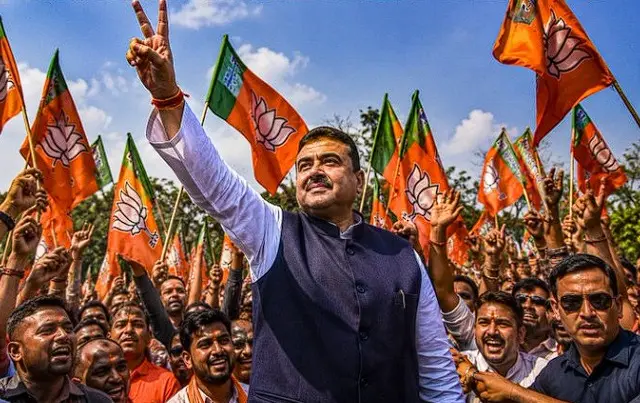
Kolkata: When Suvendu Adhikari was sworn in as the BJP’s first chief minister of West Bengal on Saturday, it brought to a close one of the most striking political partnerships in contemporary Indian politics. For close to 20 years, Adhikari was far from an ordinary lieutenant to outgoing chief minister Mamata Banerjee. He was one of her most trusted commanders, a street-fighter and organiser who converted her charisma into a finely tuned booth-level machine across large parts of Bengal.
He rose in tandem with her, stood by her through the Trinamool Congress’s prolonged contest with the Left Front and helped shape the party’s expansion into rural Bengal. However, the man who once drove Mamata’s political movement ultimately became the instrument of her defeat, as reported by The Economic Times.
Succession, Defection & Return Bout
Adhikari’s journey is less about betrayal or raw ambition than about Bengal’s shifting political grammar. It shows how personality-driven parties falter on succession, how cadres move with changing power and how organisation can trump ideology. He grasped early that the BJP’s rise in Bengal needed more than Delhi’s rhetoric – it needed a local machine and someone to run it. He became that force, and in doing so, the protégé toppled his mentor.
Suvendu Adhikari did not enter politics as an outsider. He hails from a powerful political family in Purba Medinipur, where his father, Sisir Adhikari, moved from the Congress to join Mamata Banerjee in Trinamool’s early days. The Adhikaris built a durable network through cooperatives, municipalities transport unions and rural patronage — the kind of local infrastructure that often matters more in Bengal politics than ideological conviction.
A Career Built In Trenches
Unlike many second-generation politicians who depend on lineage, Suvendu earned his standing through relentless grassroots work. Colleagues remember him less as an orator and more as a logistics-driven organiser, obsessed with booths and local networks. He personally cultivated district workers, remembered names and swiftly stepped into local disputes. In Bengal’s intensely local political culture, that approach mattered enormously.
Nandigram and After
Nandigram was the defining inflection point in Suvendu Adhikari’s rise. The 2007 land acquisition stir against the Left Front recast Bengal’s politics and thrust him into statewide view. What started as a protest over farmland for industry turned into a powerful symbol around which Mamata Banerjee mounted her final assault on the Left’s 34-year rule. She became the public face of the agitation, while Suvendu worked as a key strategist on the ground, mobilising villagers and sustaining the movement in what would later become his bastion.
He saw how fears over land, identity and state violence could be channelled into a lasting anti-Left front. In Nandigram, Adhikari proved he could fuse agitation with organisation, setting up local committees, driving mobilisation and keeping communication alive where state control had ebbed. It was then that Mamata began to see him as more than a district strongman – as a future pillar of the party. His stature surged after Trinamool’s 2011 victory, when he took on key ministries and expanded the party’s reach in southern Bengal. His later move to contest and defeat Mamata Banerjee from Nandigram in 2021 sealed their rivalry as one of Bengal’s defining political divides.
Within Trinamool, Suvendu was among a shrinking set of leaders with their own mass base, able to pull crowds without relying on Mamata’s appeal. In a tightly centralised party, that is both an asset and a source of tension.
Saturday’s oath-taking ammounted to more than a personal milestone. It captured a long political arc – from Congress to Trinamool, from anti-Left insurgent to anti-Trinamool challenger, and from protégé to rival. The organiser who once helped Mamata Banerjee seize Bengal now gets set to run the state after bringing her rule to an end.