

In Sarala Das’s Odia version of the Mahabharata, which is the first complete rendition of the epic by a single author in any language other than Sanskrit, Ganga is a wild and tempestuous woman. Born in the world of the mortals, she is a dutiful daughter who pines for Shiva as her consort. She ends up marrying Shantanu, king of the Kurus, who is a devotee of the lord. Because Shantanu was not her husband by choice, she finds inventive ways of hurting and humiliating him. She keeps him starved, by cooking tasteless food for him once in three days, beats him violently at will, tears off his clothes and destroys his scriptures. Further, she denies him physical pleasure when he seeks it from her, and forces him to make love on auspicious days when it is forbidden. Later, she kills six of their children; the seventh one, Bhishma, is saved by the father, and, thus, Ganga is freed from her marriage. Half woman, half river, her wildness is as inexplicable as a human, as is her gentility as a daughter, before her marriage.
Like Ganga, many other women in Sarala’s text are open about their desires and have no scruples regarding expressing these freely. As the Sarala scholar B. N. Patnaik says, “the Pandava women generally were manipulative, assertive, argumentative, and sometimes noisily so.” One may add here that, Sarala’s women characters are often much stronger than Vyasa’s. The Sarala Mahabharata, thus, in this and in many other ways, can be seen as the archetypal non-Brahminical Purana.
In character with this, is the hardheaded ways in which Sarala deals with sexuality. Descriptions of sexual acts in his Mahabharata are neither eroticised nor ritualised, as it is in much of medieval Odia literature of a later date, that was inspired by the Sanskritic canon. For example, in the Karna Parva, Drona’s step-mother is shown seducing him, and the poet does not judge her for this.
The unabashed detailing of female sexuality is often critiqued by later commentators such as Artaballabh Mohanty as signs of unbridled poetic license and bad taste. Historians of Odia literature such as Surendra Mohanty, see this as reflective of the then social milieu of Odisha marked by cultural and sexual mores of a Tantric Buddhism in decline, and of surviving matriarchal strains where patriarchal anxieties were yet to govern female sexuality completely. In a parallel fashion, depictions of marginal characters from non-elite communities, such as Hidimba and her son Ghatotkacha, are a lot more detailed in Sarala’s text, compared to that of Vyasa’s.
There is also a gruesome physicality in the descriptions of war in Sarala, especially in episodes not found in Vyasa. In a much anthologised section, Duryodhana, as the last surviving Kaurava warrior after the end of the eighteen-day war, crosses a river of blood to escape from the battlefield. He tries to swim atop one dead body after the other; all of these sink on touching. Finally, he is able to float, riding on one corpse. After having thus crossed the river, he realises that it is the body of his son, Lakshmana Kumara. These and other descriptions of battle and fighting evoke revulsion against warfare, and provide a subaltern critique of Brahminical notions of a ‘just war’.
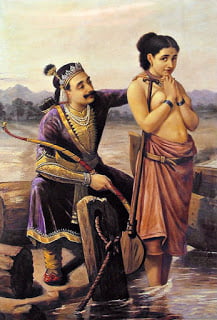
Artist – Raja Ravi Verma (1848-1906)
Photo Credit – Wikimedia Commons
Here, one may mention king Janughanta reigning over the country of Sindhumandara, who is posited as an ideal ruler in Sarala. He is a Kshatriya and a great warrior; yet, he never kills nor does he wage wars against other kingdoms. He roams around naked begging to earn a living, using all the taxes for public welfare. Perhaps because of this valourisation of subaltern notions of sociality and politics, despite scholarly criticisms, the Sarala Mahabharata remains popular.
This is despite being longer than the Vyasa Mahabharata by at least a half. The Sanskrit text is around 100,000 couplets’ long. Sarala’s text is longer by an additional 55,000 dyads or so. This is due to a narrative style favouring story-telling as its motor, rather than concerns surrounding the establishment of ‘Dharma’ as defined by the Brahminical canon.
In Vyasa, the Bhagavat Geeta, a philosophical exposition, is credited with making the war possible by inducing Arjuna to fight; in Sarala, this transition is effected through a story. When Arjun seeing his relatives arrayed in front, loses his nerve, and fails to start the war, Krishna goes to Yudhisthira to ask him to initiate battle. But even he is bought over to Arjuna’s logic and goes to the Kauravas unarmed, to plead a last chance for peace. When that fails, he tries to convince leaders of the opposing force, such as Bhishma and Karna, to switch sides; only the Kaurava prince Durddasa joins cause with Yudhisthira. When Durddasa is attacked by the Kauravas, the Mahabharata war starts.
Thus, in Sarala, the Pandavas pursue peace till the very end. The matter is not left to ‘divine’ hands like Krishna’s or the philsophising of the Geeta (an argument for war that Gandhi refused to take literally) to move the narrative forward. Arjuna’s dilemma is resolved through time, by waiting; not by any divine intervention or revelation.
In Sarala’s version, there are a large number of such episodes that are not found in Vyasa’s. Sometimes these have resonance with stories in Prakrit texts or with folktales. The Sarala Mahabharata uses a large number of words of Prakrit and Dravid origins. Sarala Das also keeps the linguistic forms of Prakritic origin of the language intact, while telling his stories in Odia. This is crucial in building a historical lineage of the Odia language; since, in most popular accounts, Odia is seen as the ‘daughter’ of Sanskrit. In fact, in the 19th century, when modern Odia was standardised through print, words with Prakrit, Arabic and Persian origins were often excised and Sanskrit equivalents were brought in. Relooking at the Sarala Mahabharata seriously opens up an window, through which we can become aware of the non-Brahminical heritage of Odia language and culture.
Note: A slightly different version of this essay was published in ‘The Hindu Sunday Magazine’ on 3rd February 2019, with the title ‘Sarala Das’s Odia Mahabharata is one of its kind’.





