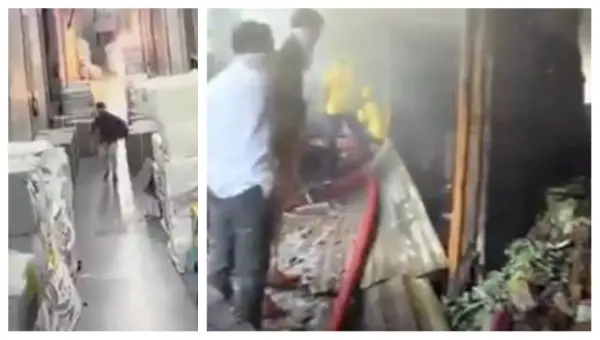
A man allegedly burns down a textile market in Surat and goods worth about ₹24 crore are destroyed. The immediate explanation sounds almost absurd: ₹10,000 in unpaid salary. Police say Vinod Savle, a former accountant, had left his job after alleging that he was repeatedly harassed and that ₹10,000 remained unpaid. They allege that he returned with petrol and set fire to goods outside his former employer’s shop. The flames, however, did not understand the dispute. They spread to 17 shops belonging to four traders who had nothing to do with it. The law will now establish the evidence, culpability and punishment. But perhaps the more difficult question begins where the police investigation ends: what happens to a human mind when deprivation, helplessness and humiliation continue for long enough?
We tend to look at ₹10,000 and ₹24 crore and wonder how anybody could destroy so much over so little. But perhaps we are looking at the wrong mathematics. For someone with savings, family support and the assurance of tomorrow’s income, ₹10,000 may be an inconvenience. For someone without money for months, it can mean food, rent, medicine and survival. Prolonged poverty does something more profound than empty a bank account. It changes the relationship between a person and the world around him. Tolerance becomes thinner. Every unpaid amount feels larger. Every humiliation cuts deeper. Every act of exploitation begins to feel deliberate. A person can slowly move from I need my money to you have no right to take what is mine, and eventually to I will not allow you to take anything from me again. Poverty does not automatically produce violence, but prolonged survival pressure can erode the restraints that prosperity quietly makes easier to maintain.
Surat has seen an earlier version of this disturbing equation. In 2024, a textile worker allegedly set fire to his factory after the owner refused his request for a ₹10,000 salary advance; the reported loss was nearly ₹67 lakh. In Pune in 2025, a driver allegedly set fire to a minibus carrying company employees amid grievances that included unpaid salary and other workplace disputes; four people died. These are crimes and must be treated as crimes. But their recurrence should also make us ask whether we are looking only at the explosion and ignoring the pressure building inside the container.
Odisha has its own reminder. In 2015, Siba Narayan Mishra, a senior executive of Mangilall Rungta’s ferro-alloy plant in Dhenkanal, was beaten to death by workers. Police reported that the accused employees had grievances relating to salary revision and regularisation. Nothing about the grievance can justify murder. But the case demonstrates that the distance between an employment dispute and violence is not always measured in money. It can be measured in power, dignity, desperation and the belief that nothing else will work.
Look also at the recent agitation of app-based auto and taxi drivers in Bhubaneswar and Cuttack. Their demands included fair fares and greater protection for gig workers. They were protesting which later turned violent. Yet beneath the demand for fares lies another anxiety: a person operates the means of his livelihood, pays for fuel and maintenance, bears the risks of illness and accident, spends hours waiting for customers and still does not know what his income will be tomorrow.
This is why the question cannot simply be whether the accused in Surat should be punished. Of course the act must be investigated and the convict punished according to law. But there is a fundamental asymmetry that our systems rarely acknowledge. The institutions investigating the crime function through salaries, procedures, authority and institutional security. The person being investigated may have spent months without any of those protections. This does not mean government employees cannot understand poverty. It means the machinery itself is not designed to experience deprivation from the perspective of the deprived. The police can establish who bought the petrol, who entered the building and what the CCTV captured. But where does the chargesheet record the months of hunger, humiliation, insecurity or perceived exploitation that preceded the act? The law examines the act. Society must examine the conditions that made the act conceivable.
And this question extends beyond workplace disputes. Across India, all types of protest, including that of students are on the rise because aspirations have risen while opportunities have not kept pace. Workers protest because economic growth does not necessarily translate into economic security. People accumulate wealth because wealth increasingly appears to be the only reliable protection against insecurity. Money stops being merely a means of living and becomes the measure of living. We accumulate the symbols of success while losing sight of the real wealth of a secure family, a healthy community, dignity at work, clean air and a liveable planet.
Not every protest, crime or act of corruption has the same cause. But many can exist within the same larger landscape: rising aspiration colliding with unequal opportunity and declining security. When everyone is told to aspire, compete and succeed, but legitimate avenues remain narrow, frustration grows. When people believe that money, connections and power determine who gets ahead, trust in institutions weakens further.
This brings us back to our government and its policies. Should public policy merely respond after desperation becomes a crime, a protest or a social disturbance? Or should government also work to prevent citizens from reaching that point? No government can eliminate poverty or inequality. But surely it can reduce the conditions that make people permanently insecure: inadequate employment, poor healthcare, unequal education, insecure work and the erosion of dignity are at a alarming high now.
By the time desperation appears in a police file, it may already be too late. The ₹10,000 has become ₹24 crore, the grievance has become a crime, and a person who once wanted only to survive has become an accused. We may punish him, as the law requires. But if we stop there, we have understood the fire without understanding the tinder.
Perhaps the larger danger is not that poverty makes people violent. It is that a society can allow desperation to accumulate silently until survival itself begins to feel like a battle—and then express surprise when somebody finally strikes a match.
(Views expressed by the columnist are personal and do not necessarily reflect the opinion or policy of the news portal)