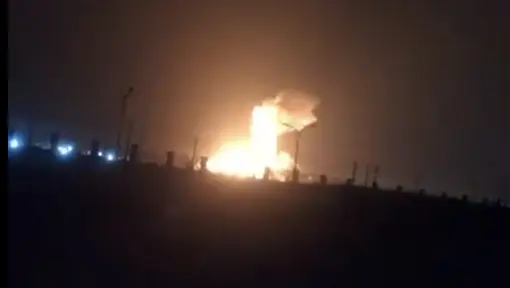
Washington: The fragile interim ceasefire in the Persian Gulf appears on the brink of total collapse as US forces launched a second consecutive day of intensive airstrikes against Iran early Thursday.
The escalation triggered a swift, wide-ranging military response from Tehran against neighbouring Gulf states, raising severe concerns that the region could descend back into full-scale war.
US President Donald Trump aggressively doubled down on the military campaign, sharing photos and video footage on social media documenting an American strike on an airbase in the southeastern Iranian city of Iranshahr. The base, according to US officials, was partially utilised by the Islamic Revolutionary Guard Corps (IRGC).
Speaking to reporters after departing a NATO summit in Turkey, Trump warned that future Iranian aggression would be met with overwhelming force, stating that the US military is prepared to hit Iranian targets “20 times harder” than any action Tehran takes against shipping vessels.
“This is in retribution for yesterday’s bombing of ships by Iran. If it happens again, it will get much worse!” Trump wrote on social media.
While he suggested any potential American campaign would “happen very fast” rather than drag into a protracted conflict, he ominously hinted that the US might “just finish the job.” Trump also renewed threats to target Iranian civilian infrastructure, including electrical and desalination plants, and floated the possibility of seizing Kharg Island, the critical hub handling roughly 90% of Iran’s oil exports.
The latest round of strikes began early Wednesday when the US targeted Iranian military and p
ort facilities following an Iranian attack on several merchant vessels off the coast of Oman. The situation worsened on Thursday morning when US Central Command ordered a broader wave of strikes. Military officials stated the operation was designed to “further degrade [Iran’s] ability to threaten freedom of navigation in the Strait of Hormuz,” a vital global transit point where a fifth of the world’s traded oil and natural gas flowed prior to the outbreak of hostilities on February 28.
Iranian state media confirmed extensive explosions at multiple locations along its southern coast. Impacts were reported in the strategic port cities of Chabahar, Konarak, Bandar Abbas, and Sirik, as well as Bushehr, which hosts Iran’s nuclear power plant complex.
A guard at the airport in the city of Iranshahr, in southeast Iran, was killed, according to the semiofficial Fars news agency.
Tehran responded immediately by launching missiles and drones into the wider region, drawing Bahrain, Kuwait, and Qatar into the crossfire. Air raid sirens blared at least twice in Bahrain, home to the US Navy’s 5th Fleet headquarters. While there was no immediate assessment of casualties or property damage in the three Gulf nations, Kuwait’s military confirmed it was actively engaging and intercepting incoming aerial threats.
The dramatic escalation has cast a dark shadow over the diplomatic process. Trump explicitly told reporters he believes the interim agreement to pause fighting is “over,” though he indicated he would allow American representatives to continue talks. “They can talk, but I think they’re wasting their time,” he remarked.
Global energy markets reacted sharply to the news, with oil prices spiking immediately following his comments.
Iranian leadership remains deeply defiant. Parliament Speaker Mohammad Bagher Qalibaf, a key figure in the peace talks, warned via a social media post on X: “America still hasn’t learned that bullying and breaking promises are no longer cost-free. Let me put it plainly: if you strike, you’ll get hit.”
Meanwhile, Deputy Foreign Minister and fellow negotiator Kazem Gharibabadi dismissed Trump’s rhetoric, asserting that the American president’s threats “are not a sign of power but an admission of the failure” of US foreign policy.