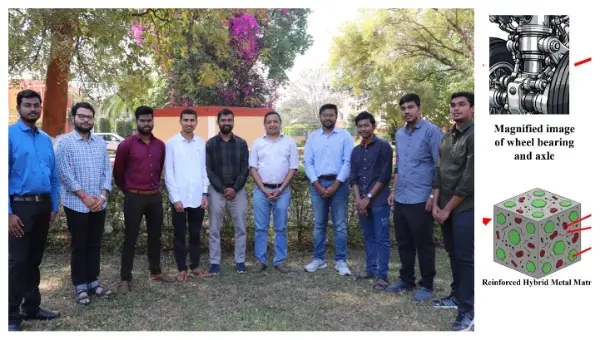
Rourkela: Researchers at the National Institute of Technology (NIT) Rourkela have developed a high-performance aluminium-based hybrid nanocomposite that promises significantly greater durability and wear resistance for aircraft landing gear.
The new material addresses a key challenge in aerospace engineering since traditional aluminium and aluminium alloys though offer the advantage of being lightweight, wear out quickly under the intense stress, friction, and impact experienced by landing gear during repeated takeoffs, landings, and taxiing operations.
According to the research team led by Prof Syed Nasimul Alam, Associate Professor in the Department of Metallurgical and Materials Engineering, the newly developed nanocomposite shows approximately 65% improvement in wear resistance, strength, and overall lifespan compared to conventional metals and alloys. It is particularly suited for use in defence aircraft and Unmanned Aerial Vehicles (UAVs), where both lightweight construction and high durability are critical.
The findings of this research have been published in the prestigious Materials Letters journal.
Nanocomposites are a mixture of materials at the nanoscale level and are more than 100,000 times thinner than a human hair.
The team, which included research scholars Dr Arka Ghosh, Dr. Ashutosh Das, Dr Pankaj Shrivastava, Nityananda Sahoo, Parth Patel, and collaborator Dr Velaphi Msomi from the University of South Africa (UNISA), created the hybrid nanocomposite by reinforcing aluminium with carbon nanotubes for enhanced compressive strength and load-bearing capacity, graphite nanoplatelets for additional reinforcement, and hexagonal boron nitride to improve thermal stability and toughness. To ensure uniform distribution of the nanoscale reinforcements within the aluminium matrix, the researchers employed high-frequency sound waves (ultrasonication). The mixture was then subjected to high-pressure compaction and processed using spark plasma sintering (SPS) in an oxygen-free environment, resulting in a dense, strongly bonded material with a three-dimensional reinforcing network that significantly improves load transfer and structural stability.
A notable feature of the nanocomposite is the formation of a thin protective surface layer that markedly reduces wear during operation. “The Al-based hybrid nanocomposites developed by spark plasma sintering (SPS) show a uniform dispersion of the nanofiller in the Al matrix and an excellent wear resistance due to the synergistic load-bearing mechanism,” said Prof Alam.
The findings of the study have been published in the reputed journal Materials Letters.
Beyond performance gains, the material is expected to offer 40-60% better overall cost-effectiveness compared to ultra-high-strength steels, titanium alloys, and conventional high-strength aluminium alloys currently used in landing gear. Its combination of reduced weight and superior wear resistance is projected to lower maintenance costs and enhance the reliability and safety of aerospace operations.
The development aligns with India’s Atmanirbhar Bharat (self-reliant India) initiative by advancing indigenous capabilities in next-generation aerospace materials. The research team has already secured a patent for the powder mixing process used in nanocomposite development and is preparing to file another for this specific technology.
Looking ahead, the group plans to scale up production by developing larger components through the Powder Metallurgy (PM) route.