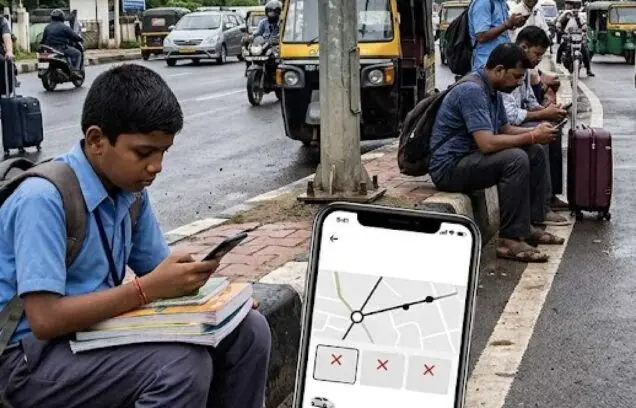
My son could not go to his tuition today. It is not a particularly dramatic event. No examination was missed, no emergency was involved and, presumably, he will make up for the missed class. Yet it made me think about how quietly app-based taxis have become part of the infrastructure of an urban life.
A ride booked on a phone is no longer merely a convenience. For many people, it is how they get to work, reach an airport, take a child to tuition, visit a hospital or simply get home. When that service suddenly disappears, an
ordinary day begins to unravel. That is what the taxi strike in Odisha has exposed—not merely a dispute between drivers and Ola, Uber or Rapido, but a much larger failure involving four players: the aggregators, the drivers, the government and, ultimately, the customer.
The immediate story is familiar. Drivers have gone on strike demanding regulated fares, compensation for waiting and traffic delays, proper cancellation charges, protection against arbitrary suspension of their accounts and greater control over the conditions under which they work. Their grievances are not difficult to understand. The driver provides the vehicle, pays for fuel, maintenance, insurance and depreciation and spends hours on the road, while
the aggregator controls access to the customer, the allocation of rides and much of the economic relationship. The driver can therefore feel remarkably powerless in relation to the platform that provides his livelihood.
But the driver occupies a very different position when dealing with the passenger. The same person who is vulnerable to an aggregator can exercise considerable power over a customer. Passengers routinely encounter drivers who cancel after discovering the destination, refuse short journeys, ask them to cancel, demand additional money or prefer particular payment methods. The customer may technically have the option of booking another vehicle, but when
several drivers behave similarly, that choice is little more than theoretical. The driver, therefore, can simultaneously be the weaker party in one relationship and the stronger party in another.
The aggregators are equally difficult to place neatly in the role of villain. They have transformed urban transportation by making a fragmented taxi market searchable, trackable and accessible from a phone. They have created opportunities for thousands of vehicle owners and made it possible for a passenger to know, at least theoretically, what a ride will cost before getting into a car or motorbike. Yet the platform model also creates a striking asymmetry. The driver bears much of the physical and financial risk, while the platform exercises considerable control over the marketplace. Account suspensions, incentives, commissions, fare structures and the allocation of rides can directly determine whether a driver earns or does not earn. The driver may be called an independent operator when responsibility is discussed, but the platform can exercise powers that resemble those of an employer when control is involved.
And then there is the customer—the fourth and least organised player in this arrangement.
The driver has an association. The aggregator has capital, technology, lawyers and an entire corporate structure. The government has laws, officials and enforcement powers. The customer has an app with a button marked “Book”. When the driver cancels, the customer suffers. When the aggregator raises the fare, the customer pays. When the government fails to enforce its rules, the customer waits. And when the entire system stops functioning, as it
has during this strike, the customer is simply stranded.
The government, however, cannot fairly be accused of having done nothing. Odisha notified its On-Demand Transportation Technology Aggregators Guidelines in 2023, bringing appbased aggregators within a regulatory framework. The state subsequently attempted to enforce licensing requirements against aggregators. The Centre introduced a fresh Motor Vehicle Aggregator framework in 2025, addressing fares, driver earnings, cancellations and
other aspects of the relationship. Odisha has also promoted Odisha Yatri, a governmen-tbacked, zero-commission alternative intended to give drivers a different model of platform-based mobility.
The question, therefore, is not whether governments have made rules. They have. The more uncomfortable question is why those rules have not produced a functioning system. If regulations exist, if licences are required, if driver earnings are supposed to be protected, if cancellation and fare practices are governed and if an alternative platform has even been created, why are drivers still protesting the same fundamental issues? Why do passengers
still face arbitrary cancellations? Why can aggregators and drivers continue to operate in a manner that leaves the customer with so little certainty?
Perhaps the answer lies in the peculiar position occupied by the government. It is the regulator, the licensing authority and the enforcer, but it does not actually operate the taxis. It must protect the driver without allowing the driver to exploit the passenger; it must regulate the aggregator without destroying the convenience the aggregator provides; and it must protect the customer without assuming responsibility for running the entire transport system. That is an extraordinarily difficult balancing act. Yet when the balance fails, somebody
has to bear the consequences.
The image of police personnel helping passengers at Bhubaneswar airport during the strike captures this contradiction almost perfectly. Police are responsible for law and order, not for providing taxi services. Yet when a privately operated mobility system becomes sufficiently important to the functioning of a city, its disruption can force the state to step in anyway. A service that was once considered a private convenience has quietly acquired the
characteristics of public infrastructure.
That is perhaps the larger lesson of the taxi strike. The problem is not that one of the four players is entirely good and another entirely bad. The driver wants a livelihood. The aggregator wants a viable business. The government wants a regulated market without having to run it. The customer wants nothing particularly unreasonable either: a car to arrive when the app says it will, at a price that does not suddenly change, without having to negotiate with the person behind the wheel.
All four demands are legitimate. The problem is that they frequently collide, and there is no sufficiently effective mechanism to reconcile them. Each player has somebody else to blame and somebody else’s power to resist. The driver blames the aggregator. The aggregator points to market conditions and driver behaviour. The government points to regulations and enforcement mechanisms. The customer is left pointing at a screen wondering why the car that was supposedly coming has disappeared.
This is no longer merely a taxi problem. Modern cities increasingly depend upon private platforms for services that have become essential to everyday life. The state regulates them, private companies operate them, workers sustain them and citizens depend upon them. But when the system breaks, accountability becomes remarkably elusive. That may be the real failure exposed by the Odisha strike: not the absence of rules, but the absence of anyone who is ultimately responsible for making the whole system work.
My son missing tuition today is hardly a crisis. Tomorrow, the taxi may arrive and life will return to normal. But perhaps that is how modern urban systems reveal their vulnerabilities— not through spectacular collapse, but through hundreds of small disruptions that we have learned to accept. A cancelled ride. A missed class. A delayed appointment. A stranded passenger. Each is individually insignificant. Collectively, they tell us something important. We have built a city in which four different players control different pieces of the journey.
The uncomfortable question is: when the ride doesn’t come, who exactly is responsible for the citizen who is left waiting?
(Views expressed by the columnist are personal and do not necessarily reflect the opinion or policy of the news portal)