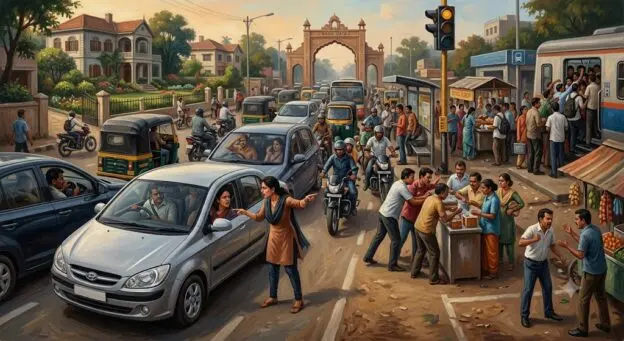
A few days ago, two ladies, seemingly in their early thirties drove onto the wrong side of a road near Naka Gate and stopped directly in front of my car. They wanted to diagonally cross the road to reach their house on the other side. Had I not stopped, our cars would have collided; having stopped, I found myself blocking the traffic behind me. When I asked them to move, they argued that their house was right there and that I should reverse and let them pass. One of them got out of the car and abused me for not acting fast. What stayed with me was not the traffic violation. It was the reasoning behind it. Their convenience had created inconvenience for several other people, but there seemed to be no recognition that this was a problem. They needed to get home. Therefore, everyone else had to adjust.
It was a small incident, hardly worth remembering. Yet I have begun to wonder whether these small incidents are perhaps the most honest way of conducting a Citizen’s Ledger—not an audit of the government this time, but an audit of ourselves. Because the same behaviour is everywhere. We jump queues because somebody might get ahead of us. We drive on the wrong side because the proper route is inconvenient. At a traffic signal, we push our cars towards the front and block the free-left because we want to be ahead when the light changes. We flash the left indicator and turn right because it gives us an advantage over the person behind. We push into trains and elevators before others have got off. We stand up the moment an aircraft lands and rush towards the exit, although we know perfectly well that the aircraft cannot leave without us. We fight over parking spaces, squeeze ahead at counters and gather around anything being distributed free.
There is always this strange urgency to get there first, take it first, secure it first. And after a while one begins to wonder: what exactly are we afraid of losing? The road is not going to disappear. The train will not leave without us before scheduled departure time. The aircraft will not take off again because we remained seated for another five minutes. There will be another parking space, another bus, another opportunity. Yet we behave as though every small delay could cost us something permanently. This is FOMO, not the social-media kind. It is a much older fear of missing out—a fear that if I don’t grab something now, somebody else will take it.
Perhaps this explains our extraordinary hankering for more. More money, more property, more status, more benefits, more security, more of everything, preferably with the least possible effort. The shortcut becomes more attractive than the journey, the connection more useful than competence and the bribe more efficient than the process. It is not merely greed. It is a restless inability to believe that there will be enough. Could this be the psychological residue of sustained poverty or simply a survival mechanism?
A society that has experienced generations of scarcity naturally learns to secure its share before somebody else does. If the resource is limited (and many a times, it is), take yours first. If the opportunity is limited, reach it first. If the government is distributing something, get into the crowd. If there is a queue, find a way around it. Perhaps poverty can therefore survive as a habit of the mind long after it stops being a person’s economic condition. A man can own a large house, drive an expensive car and have money in the bank and still behave as though there is one last piece of bread in the world.
Material prosperity does not necessarily produce psychological abundance. And perhaps this is where corruption begins to look less mysterious. We usually imagine corruption as something done by politicians, officials or businessmen. But the instinct is much smaller and much closer to home: What can I get? What can I save? Can I get ahead? Can I bend this rule? Why should I wait if I can avoid waiting? The large corruption of institutions may simply be the enlarged version of thousands of small compromises that we have learnt to accommodate. We may dislike corruption when it works against us and accept it rather comfortably when it works for us.
There is another curious feature of this behaviour. We are remarkably good at obeying rules when somebody is watching. Put a traffic policeman at a junction and discipline suddenly appears. Remove him and the rules become negotiable. It is almost as though we need to be governed before we can govern ourselves. Self-restraint—doing the right thing when nobody is watching—seems considerably harder than obedience when punishment is visible. And perhaps that is the more difficult question this little traffic incident raises: why does an authoritarian presence have to determine the limits of my behaviour?
Perhaps this is also why we find it difficult to think beyond the immediate and beyond ourselves. We speak constantly about securing the future of our children. We want them to have better houses, better education, better jobs and more money than we had. But our idea of securing their future often seems to mean accumulating more for them. We rarely think about the society they will inherit—the roads they will drive on, the institutions they will depend upon, the strangers they will have to trust, and the civic habits they will themselves learn. We may be leaving them money while simultaneously leaving them a culture in which everyone is still fighting everyone else for an extra inch.
There is something almost extraordinary about Norway’s decision to put much of its petroleum wealth into a fund intended to benefit not only the present generation but future generations. The idea is simple enough: what belongs to us today need not be entirely consumed by us today. Much of it can be left untouched for people who do not yet exist. Norway’s Government Pension Fund Global is something almost utopian when viewed from the Indian street. We struggle to leave enough road for the person immediately behind us, while another society has institutionalised the idea of leaving wealth for people who have not yet been born.
Perhaps our problem is not that we want too much. Perhaps it is that we have never quite learnt what enough feels like. We are a young republic, only eight decades into our independent existence, and most Indian families are only a few generations removed from lives shaped by rural poverty, insecurity and scarcity. Maybe some of that instinct still remains. Maybe it explains the urgency, the grabbing, the suspicion and the endless hankering. Or perhaps there are other explanations. I don’t know. But if we are conducting a Citizen’s Ledger, perhaps the point is not to arrive at a verdict but to ask uncomfortable questions of ourselves.
I keep thinking about those two women. What if, from their point of view, they were not doing anything particularly wrong? What if they genuinely believed that getting home was reason enough for everyone else to stop, reverse and make way? And if that instinct exists in them, perhaps it exists in smaller ways in the rest of us too. Perhaps every queue we jump, every rule we bend, every shortcut we take and every time we insist that our convenience must come first is another small expression of the same fear. What if the thing we are so fearful of missing out on, is actually not running out? What if, after generations of believing that there will never be enough, we have simply forgotten what enough looks like?
(Views expressed by the columnist are personal and do not necessarily reflect the opinion or policy of the news portal)