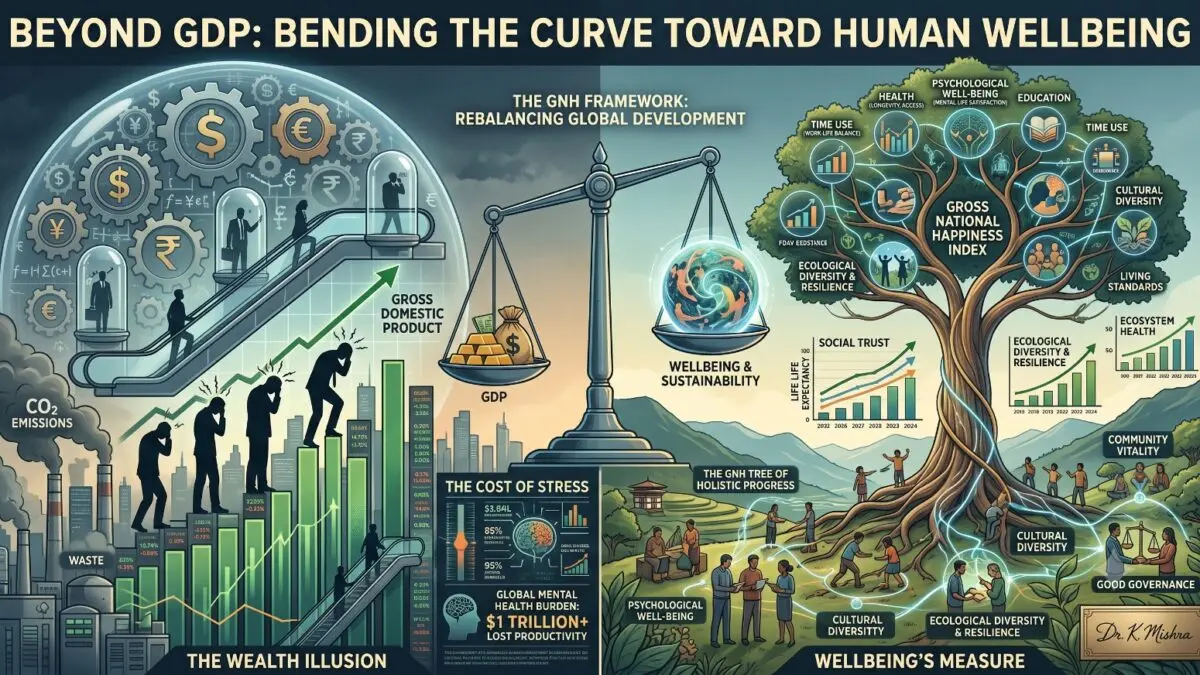
Every quarter, governments celebrate rising GDP. Stock markets respond, investors applaud, and politicians claim success. Yet a simple question remains largely unanswered: Are people actually living better lives?
Nearly a century ago, economist Simon Kuznets, who pioneered national income accounting, warned that “the welfare of a nation can scarcely be inferred from a measurement of national income.” His caution was largely ignored. Gross Domestic Product became the global shorthand for progress, despite measuring only the value of goods and services produced—not the wellbeing of the people producing them.
Today, the evidence suggests Kuznets was right.
The World Happiness Report 2026 once again places Finland at the top of global wellbeing rankings. Denmark and Iceland follow closely. Meanwhile, the United States, the world’s largest economy, ranks only 23rd, while India, despite sustained economic growth averaging over 6 per cent annually in the past decade, ranks 116th. Economic expansion has not translated proportionately into life satisfaction.
This disconnect is not accidental. It reflects what economists have long called the Easterlin Paradox: beyond a certain level of prosperity, higher income does not necessarily produce greater happiness. Once basic needs are met, factors such as mental health, social trust, community relationships, environmental quality, and personal freedom become stronger determinants of wellbeing than income alone.
At the same time, the world faces an unprecedented mental health challenge. The World Health Organisation estimates that more than one billion people live with a mental health condition. Depression, anxiety, loneliness, and suicide impose immense human suffering while costing the global economy hundreds of billions of dollars each year in lost productivity. GDP records the treatment costs, but it does not measure the erosion of wellbeing that creates those costs in the first place.
Against this backdrop, a small Himalayan nation offers an alternative perspective.
Bhutan introduced the concept of Gross National Happiness (GNH) in the 1970s, arguing that the purpose of development should be the wellbeing of citizens rather than the accumulation of wealth alone. What initially appeared to many as an idealistic slogan has gradually evolved into one of the world’s most sophisticated systems for measuring multidimensional wellbeing.
Unlike conventional happiness sur
veys, Bhutan’s GNH Index assesses citizens across nine domains, including psychological wellbeing, health, education, time use, community vitality, culture, governance, ecological resilience, and living standards. The framework employs the internationally recognised Alkire–Foster methodology, allowing policymakers to identify precisely where wellbeing is improving or deteriorating.
More remarkably, Bhutan embedded this philosophy into its Constitution. Article 9 requires the State to promote conditions that enable the pursuit of Gross National Happiness. Major public policies and development projects are screened not only for economic returns but also for their social and environmental consequences.
This is not a rejection of economic growth. Bhutan continues to pursue higher incomes, expand infrastructure, and strengthen its economy. The crucial difference is that growth is treated as a means to improve human wellbeing rather than as an end in itself.
The broader lesson is not that every nation should replicate Bhutan’s constitutional model. Bhutan’s geography, population, political system, and cultural context are unique. No single framework can simply be transplanted into vastly different societies.
However, Bhutan demonstrates something profoundly important: governments can systematically measure and govern wellbeing alongside economic performance.
Many countries have already begun moving in this direction. New Zealand has adopted wellbeing budgeting. The United Kingdom measures national wellbeing through the Office for National Statistics. International organisations increasingly recognise that sustainable development requires balancing economic prosperity with social cohesion, environmental sustainability, and mental health.
The debate, therefore, should no longer be framed as GDP versus happiness. Modern economies need both. GDP remains indispensable for measuring production, trade, employment, and fiscal performance. Yet it cannot tell us whether people enjoy meaningful relationships, good mental health, clean environments, or confidence in public institutions.
As climate change, demographic shifts, and mental health challenges reshape societies, governments will increasingly need indicators capable of measuring what truly matters. Nations that ignore these dimensions risk becoming wealthier while simultaneously becoming less resilient, less cohesive, and less satisfied.
The ultimate purpose of public policy is not simply to maximise production. It is to improve the quality of human life.
Bhutan’s greatest contribution is not proving that happiness can replace economics. It is demonstrating that wellbeing can become a measurable, evidence-based objective of governance. In an era when prosperity alone no longer guarantees flourishing, that lesson deserves serious global attention.
Perhaps the defining question for the twenty-first century is no longer “How fast is the economy growing?” but “How well are people living?”
The countries that answer both questions together may ultimately prove to be the most successful of all.