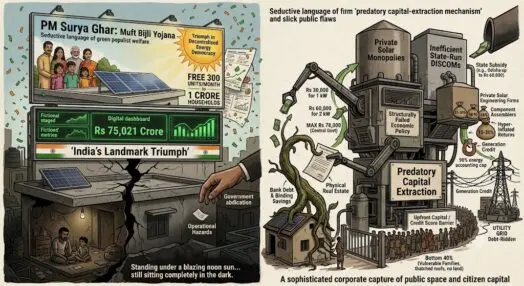
India’s Rs 75,021-crore PM Surya Ghar: Muft Bijli Yojana is being aggressively marketed across the nation as a landmark triumph in decentralised energy democracy. Promising up to 300 units of free electricity per month to one crore households, the scheme uses the seductive language of green populist welfare. However, stripped of its slick bureaucratic public relations and staged digital dashboards, the policy reveals a deeply troubling framework.
It acts as a predatory capital-extraction mechanism that systematically transfers financial risk and physical real estate from the citizen to private corporate monopolies and inefficient state-run power distribution companies (DISCOMs). What is packaged as an environmental gift to the nation is, in reality, a structurally failed economic policy. The most glaring deception within the scheme is the false promise of domestic energy security. Millions of
homeowners across India are investing their hard-earned liquid savings or binding themselves to bank debt under the assumption that having solar panels on their concrete roofs will protect their families during grid failures.
In truth, the scheme exclusively finances grid-tied (on-grid) systems that lack expensive battery storage. By law, these systems are engineered to shut down automatically the exact second the main power grid goes offline. A citizen can stand under a blazing noon sun with thousands of rupees worth of generating assets on their property and still sit completely in the dark during a blackout. Genuine self-reliance has been entirely sacrificed to protect utility grid stability.
Instead of deploying public wealth to build sovereign, long-lasting state infrastructure, the government has offloaded the operational hazards directly onto the taxpayer’s roof. The financial architecture of the programme is deliberately engineered to drain public liquidity while locking in massive corporate profit margins.
The central government heavily publicises its baseline subsidy structure: Rs 30,000 for a 1 kW system, Rs 60,000 for a 2 kW system, and a maximum cap of Rs 78,000 from the central government for 3 kW systems.
In states like Odisha, the state government has attempted to sweeten the deal by introducing an additional state subsidy of up to Rs 60,000 for a 3 kW setup, bringing the total combined subsidy to an impressive-looking Rs 1,38,000. To further lower entry barriers, authorities have declared that metering charges are now free, absorbing the standard Rs 1,875 cost typically associated with a Utility-Led Asset (ULA) model setup.
However, these financial injections do not alter the foundational economics; they merely mask them. This
multi-layered “subsidy” is entire
ly funded by the public’s own indirect taxes. The citizens fund 100% of the project through their tax contributions, while private solar engineering firms, component assemblers, and conglomerates pocket guaranteed, hyper-inflated returns.
Industry data shows that empanelled private vendors enjoy gross profit margins ranging from 15% to 30% per rooftop installation, while large corporate distributors boast margins as high as 35% on project execution. Private players inflate the base costs of solar components to quietly absorb the state subsidy, leaving the consumer to pay an artificial premium for imported or substandard parts.
Meanwhile, the bottom 40% of the population—the truly vulnerable families with thatched roofs, non-availability of grid infrastructure or no land—remain completely barred from participating because they lack the residual upfront capital or credit scores to qualify for loans. This represents a highly regressive transfer of public wealth that fails future generations by failing to build equity.
The exploitation of the consumer becomes particularly clear when looking at the ground reality in states like Odisha. Operating under privatised distribution networks managed by corporate utilities like TPCODL and TPWODL, the
implementation of the scheme exposes serious gaps in accountability. Even with free meter connectivity, the Odisha Electricity Regulatory Commission (OERC) clamps down via a 90% energy accounting cap.
Odisha’s regulations state that total solar generation is capped cumulatively at 90% of the consumer’s consumption at the end of the financial year. If a household’s panels over-produce during high-sunshine months, the surplus energy is not fairly compensated; it is absorbed by the DISCOM, leaving the consumer with zero financial leverage. The ultimate structural risk rests in the absolute volatility of utility pricing.
DISCOMs across India are notoriously debt-ridden and routinely manipulate feed-in tariffs to cut their losses. Even if a state regulatory commission announces a temporary freeze on retail supply tariffs, DISCOMs retain the unilateral policy leverage to alter net-metering regulations, slash the value of solar export credits, or levy “grid-balancing charges” on solar consumers at any moment.
Once a citizen surrenders their liquidity and locks into a 25-year system of degrading hardware, they have no bargaining power. If the DISCOM decides to slash the payout for exported solar power from Rs 4.40 per unit down to a fraction of that cost, the consumer has no choice but to accept the loss.
The PM Surya Ghar scheme remains a highly sophisticated corporate capture of public space and citizen capital packaged as a climate-conscious welfare initiative. By forcing citizens to carry the remaining upfront cost, absorb structural debt, accept un-auditable “black-box” smart meters, and still suffer through blackouts, the government has abdicated its responsibility to build durable public utilities.
This is not authentic nation-building; it is an aggressive, short-sighted transfer of public wealth that leaves the everyday consumer holding the financial bill for an energy system rigged entirely in favour of corporate and grid monopolies.
(Views expressed by the columnist are personal and do not necessarily reflect the opinion or policy of the news portal)